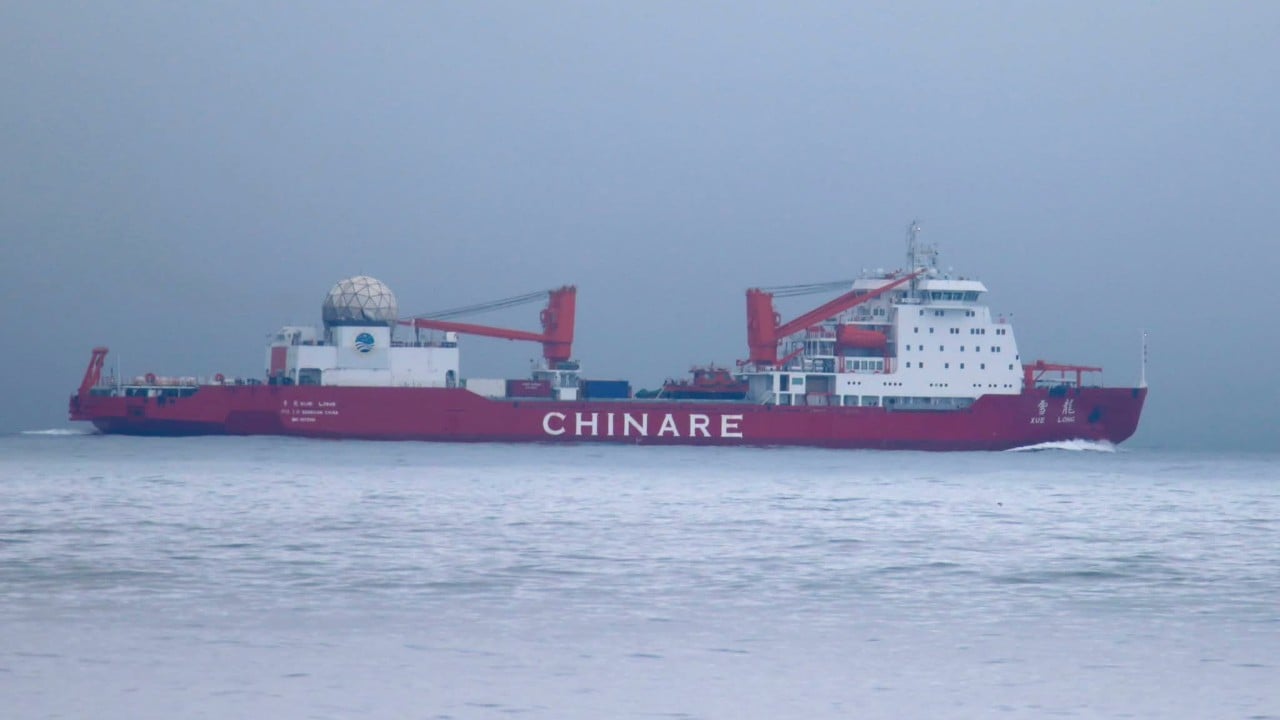
When the Chinese polar icebreaker Xue Long 2 cut through sea ice near Alaska, officials in Washington did not view the voyage as a triumph of marine biology. They viewed it as a high-latitude intelligence operation.
The official narrative from Beijing remains straightforward. China claims its expanding footprint in the High North is focused on environmental monitoring, sea-ice dynamics, and global climate shifts. Yet, behind the scientific press releases lies a stark geopolitical reality. Beneath the frozen crust of the Arctic Ocean, the line between academic discovery and naval reconnaissance has dissolved. Hydroacoustic arrays deployed to study ice melt can track military submarines with equal precision. Bathymetric surveys mapping the seabed for geological research gather the exact topographical data required for nuclear submarine navigation through critical underwater chokepoints. You might also find this connected article interesting: The Syrsky Sacking Narrative Is Complete Propaganda.
American security planners are unnerved by how rapidly Beijing has turned a self-proclaimed status as a "near-Arctic state" into an operational presence at the top of the world. The anger emanating from the Pentagon and Capitol Hill is not driven by simple paranoia. It is fueled by the stark realization that Western defense networks overlooked the Arctic for two decades while Beijing quietly established the infrastructure, partnerships, and technology required to operate in the harshest environment on Earth.
The Dual Use Oceanography Problem
To understand why a research ship triggers alerts in Washington, one must look below the surface. Submarines rely on density profiles, water temperature gradients, and precise bathymetric maps to navigate without active sonar. A crew diving in dark, freezing waters needs to know where undersea mountains rise and where thermoclines hide them from adversary hydrophones. As reported in detailed articles by TIME, the effects are significant.
China’s Polar Research Institute has spent years dropping listening devices and hydroacoustic sensors directly into the Arctic basin. Officially, these devices track marine life and ocean currents. Operationally, they provide a continuous stream of environmental data that can optimize submarine detection algorithms and refine underwater acoustic models.
Consider a basic technical function of polar research. When a research vessel deploys autonomous underwater vehicles to study ice thickness, those same vehicles collect sea-bed mapping data that can be fed straight into naval database systems. There is no structural difference between a sensor measuring physical oceanography and a sensor deployed for anti-submarine warfare.
Beijing’s civil-military fusion doctrine guarantees that civilian oceanographic data flows straight to the People’s Liberation Army Navy. Every hydrographic survey conducted by vessels like the Xue Long 2 or the newer Jidi builds a oceanographic database for future naval operations. If Chinese nuclear-powered ballistic missile submarines ever decide to patrol under the polar ice cap to evade Western tracking systems, they will navigate using maps generated under the guise of climate research.
┌─────────────────────────────────────────────────────────────────┐
│              THE DUAL-USE ARCTIC RESEARCH SPECTRUM              │
├───────────────────────────────┬─────────────────────────────────┤
│ Stated Civilian Objective     │ Defense Application             │
├───────────────────────────────┼─────────────────────────────────┤
│ Seabed Bathymetry Mapping     │ Submarine Navigation Trajectories│
│ Hydroacoustic Ice Tracking    │ Undersea Anti-Submarine Sonar   │
│ Satellite Ground Stations     │ Real-Time Vessel Tracking & ISR │
│ Deep-Sea Autonomous Drones    │ Undersea Cable Inspection & ISR │
└───────────────────────────────┴─────────────────────────────────┘
This dual-use reality explains why American lawmakers introduced bipartisan legislation aiming to bar Chinese-affiliated vessels from conducting marine research within the U.S. Exclusive Economic Zone. The Arctic Security and Diplomacy Act is an effort to plug a legal loophole that allowed Beijing to gather critical data on marine environments directly off Alaska’s shores.
The Moscow Connection and the Northern Sea Route
China did not reach the central Arctic Ocean in a vacuum. It rode in on Russia's geopolitical vulnerability.
Historically, Moscow treated its northern coastline as an exclusive fortress. Russian security apparatus viewed any foreign presence along the Northern Sea Route with deep suspicion. For decades, the Kremlin barred non-Russian vessels from transit without strict supervision and heavy fees.
The full-scale invasion of Ukraine changed that dynamic overnight. Cut off from Western capital, Western maritime engineering, and European energy markets, Moscow was forced to hand Beijing the keys to its Arctic backyard.
Chinese state-owned enterprises stepped into the breach, funding major Russian Arctic energy developments such as Yamal LNG and Arctic LNG 2. Hundreds of Chinese companies registered in Russian-controlled Arctic territories to build deep-water ports, rail lines, and shipping lanes. In return, Beijing gained unprecedented access to the Northern Sea Route, a maritime shortcut that shaves thousands of miles off shipping journeys between East Asia and Europe.
"Russia has become economically and politically dependent on China in ways that override its traditional instincts to guard the Arctic," notes a senior European defense analyst based in Stockholm. "Moscow used to treat the High North as a private sanctuary. Today, it serves as the enabler for Beijing's northern expansion."
The collaboration went beyond economic investments. In recent years, joint Russian and Chinese naval task forces have executed patrols through the Bering Sea, sailing in international waters just off Alaska's Aleutian Islands. Chinese strategic bombers have flown joint missions with Russian bombers near Alaskan air defense zones.
This alignment presents North America with a multi-front security challenge. What was once considered a low-tension region managed through scientific cooperation has transformed into a venue for power projection.
The American Icebreaker Deficit
While Beijing and Moscow built fleets and established polar infrastructure, Washington watched from the sidelines, handcuffed by procurement failures and shifting political priorities.
The physical reality of polar power comes down to steel hulls and engines. Icebreakers are the absolute requirement for sovereignty in high latitudes. Without them, coast guards and navies cannot enforce maritime laws, protect undersea cables, or conduct search-and-rescue operations.
| Country | Active Icebreakers | Key Capability Focus |
|---|---|---|
| Russia | 40+ (including nuclear-powered) | Heavily armed, year-round Northern Sea Route enforcement |
| China | 4+ expanding rapidly | Scientific, hydrographic mapping, dual-use drone deployment |
| United States | 2 (1 heavy operational, 1 medium) | Aging Coast Guard hulls, long procurement delays |
The stark disparity in icebreaking capacity—often called the "icebreaker gap"—left the United States severely constrained off its own northern border. The U.S. Coast Guard’s heavy icebreaker Polar Star is an aging vessel held together by dedicated technicians and scavenged parts.
Recognizing this gap, Washington scrambled to form the ICE Pact—a partnership joining the United States, Canada, and Finland to pool polar shipbuilding capacity. Parallel efforts to fund new Arctic Security Cutters have accelerated. But industrial shipyards cannot build heavy ice-capable vessels overnight. The first of these new American cutters is not slated to hit the water for years, leaving a dangerous window where Chinese and Russian vessels operate with numerical superiority.
This structural delay explains the political anger in Washington. American officials realize they are reacting to a strategy China set in motion fifteen years ago. Beijing saw the melting polar ice cap coming, calculated its strategic value, and built the industrial capacity to exploit it while Western planners were focused elsewhere.
Beneath the Ice and Beyond the Horizon
The friction in the Arctic Ocean extends beyond surface ships and submarine routes. It reaches into orbit and across deep ocean floor infrastructure.
Modern polar research relies on ground stations to downlink satellite imagery and sensor data. China has built tracking stations in foreign territories, raising concerns among NATO allies that these facilities serve dual-use intelligence functions. Satellite tracking stations positioned in high-latitude environments provide coverage of polar-orbiting spy satellites, offering real-time intelligence on military movements across North America and Europe.
At the same time, the deployment of uncrewed platforms is altering polar warfare. China’s development of long-range autonomous underwater vehicles (AUVs) gives its oceanographers the ability to explore underneath ice shelves without risking human lives. The same autonomous systems, configured for defense missions, can monitor vital seabed fiber-optic cables that carry transoceanic data traffic.
If a conflict breaks out in the Western Pacific, disruption of northern communications or undersea infrastructure could delay Western responses. By laying the groundwork for a permanent polar presence today, Beijing secures an operational platform for asymmetric options tomorrow.
The United States is finally moving to challenge this presence. Coast Guard patrols off Alaska have increased. Maritime surveillance aircraft track every research ship that approaches the Bering Strait. Legislative barriers are shutting down access to sovereign territorial waters.
Yet, closing the gap requires more than legislative bans or reactionary patrols. It demands sustained industrial investment, continuous icebreaking presence, and a clear-eyed assessment of how civilian science is weaponized in contested space. As the ice recedes, the High North is losing its role as an isolated sanctuary, taking its place as a central theater of global strategic competition.