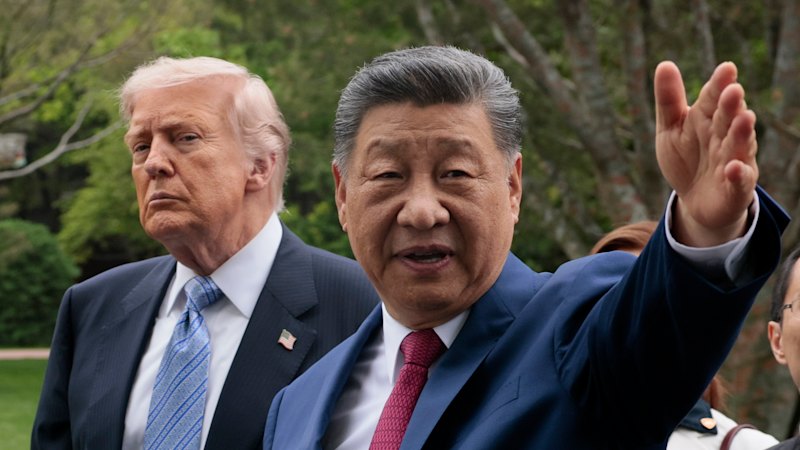
The room in Lima was quiet, the kind of heavy, conditioned silence found only in high-security diplomatic suites. Outside, the Peruvian spring hummed. Inside, two men sat across from each other, surrounded by aides who held their breath. It was late 2024. Joe Biden was preparing to step off the global stage. Donald Trump was preparing to reclaim it.
Sitting across from the American delegation, Xi Jinping did not offer the usual diplomatic platitudes. He spoke with a cold, deliberate precision. He laid out four "red lines" that America must not cross.
To the untrained ear, the list sounded like standard Beijing rhetoric: Taiwan, democracy, China’s political system, and China's right to economic development. The political pundits on cable news fixated immediately on Taiwan. They always do. Tanks, ships, and missile silos are easy to visualize. They fit neatly into a 30-second news segment.
But the pundits missed the real story. The true threat—the one that could quietly fundamentally alter the daily life of every single citizen in the West—was wrapped in the vague phrase "development rights."
It is a euphemism for a silent, invisible war. And we are already losing it.
The Microscopic Border
To understand what Xi actually meant, you have to look past the South China Sea. You have to look at something much smaller. Infinitesimally smaller.
Imagine a specialized factory floor in any Western country. Let's call the lead engineer Sarah. For twenty years, Sarah has watched her company manufacture high-tech medical imaging equipment. Her machines save lives every day, spotting tumors before they can spread. She is proud of her work. She feels secure.
Then, the supply chain shifts.
The advanced microchips Sarah relies on, the ones capable of processing complex AI algorithms in milliseconds, become unavailable. Not because of a shipping delay. Not because of a natural disaster. But because the raw gallium and germanium required to make them—mined and processed almost exclusively in China—have been restricted.
Sarah’s factory slows to a crawl. Layoffs follow. The hospital down the street can't replace its aging MRI machines. Wait times for cancer screenings tick upward.
This is not a hypothetical nightmare. This is the reality of the economic chokehold Xi signaled in Lima.
When Beijing talks about the "right to development," it isn't pleading for permission to grow. It is issuing a fierce directive. China is no longer content being the world’s cheap assembly line. It wants to own the intellectual architecture of the future. It wants the monopoly on green technology, advanced computing, and electric vehicle infrastructure.
Xi's warning to Trump was simple: If Washington continues to block China's access to advanced American technology, Beijing will cut off the world's access to the foundational materials that power the modern age.
The Trap of the Tech Blockade
For years, Washington has operated under a comfortable assumption. The logic went like this: If we restrict China’s access to our high-end semiconductor technology, we freeze them in time. We maintain our lead.
It felt like a winning strategy. It was clean. It was decisive.
But anger a giant, and it adapts. By cutting off the supply of American chips, the West forced China to build its own ecosystem. What was meant to be a containment strategy became an accelerant.
Walk through the tech markets of Shenzhen today, and you won't see engineers weeping over missing American components. You will see a feverish, state-funded rush to achieve total technological independence. Huawei’s recent smartphone releases, powered by sophisticated domestic chips that Western experts claimed China couldn't produce for another decade, proved the blockade has holes.
The strategy backfired because it ignored a fundamental truth about global trade. We are not independent nations playing a game of checkers. We are conjoined twins sharing a single circulatory system.
China controls roughly 80% of the world’s supply of rare earth elements. These aren't just used for smartphones. They are vital for defense systems, wind turbines, and the guidance packages of the very missiles meant to deter conflict.
The true red line isn't a geographical boundary around an island in the Pacific. It is a digital perimeter. If the United States pushes too hard on technological sanctions, China can flip a switch and starve Western tech companies of the raw elements they need to breathe.
The Quiet Reality of Conflict
When we think of international conflict, we think of fire and steel. We think of the dramatic, cinematic moments of history.
The conflict Xi is preparing for is different. It is gray. It is grinding. It is the slow, suffocating pressure of economic decoupling.
Consider what happens next if this invisible line is crossed. It won’t begin with an explosion. It will begin with an email.
An automotive executive in Detroit opens a memo stating that the lithium-ion batteries required for their entire upcoming line of vehicles will cost 40% more due to new export controls from Beijing.
A consumer in London logs onto a website to buy a laptop, only to find prices have doubled and delivery dates are pushed back six months.
A software startup in Silicon Valley finds its access to critical global datasets blocked, crippling its ability to train its algorithms.
This is how a modern superpower fights. Not by invading a beachhead, but by making the daily existence of its adversary prohibitively expensive, technologically stagnant, and deeply frustrating.
We have spent decades building a world where efficiency was king. We put our factories where labor was cheap and assumed the roads between us would always remain open. We forgot that trade is a weapon just as easily as it is a bridge.
The Conversation We Aren't Having
The true danger of Xi’s warning is that the Western public is largely blind to it.
Politicians can easily rally voters around the defense of a democracy abroad. They can point to maps. They can show satellite imagery of troop movements.
They cannot easily explain the intricacies of the global supply chain for processed graphite. They cannot write a catchy slogan about the refining capacity of lithium.
So, they don't. They stick to the old scripts. They talk about tariffs as if they are magic wands that can be waved without consequence. They talk about decoupling as if it is as simple as unplugging a television from the wall.
It is confusing. It is deeply uncertain. It forces us to admit that we are vulnerable in ways we don't want to acknowledge. We want to believe that Western ingenuity can solve any problem, that our dominance is a natural law of the universe.
It isn't.
Every piece of technology you touch today—the screen you are reading this on, the car you drive, the grid that powers your home—is bound by the invisible threads of a geopolitical truce that is currently fraying at the edges.
The Final Chords
The meeting in Lima ended. The leaders shook hands. The motorcades rolled away into the Peruvian night.
To the public, it was just another summit, another photo-op in a long line of forgotten diplomatic gatherings. But the message had been delivered, and the clock is ticking.
The coming years will not be defined by a single, dramatic choice between war and peace. They will be defined by thousands of smaller, agonizing choices made in boardrooms and government offices. Do we compromise on our security to keep our supply chains moving? Do we accept a poorer, slower world in exchange for ideological purity?
There are no easy answers. There are no clean victories.
Somewhere, on an automated assembly line, a robotic arm swings down to place a microscopic component onto a green circuit board. The machine doesn't care about politics. It doesn't care about red lines, or summits, or the pride of nations. It just needs the metal to keep coming. And for now, the hand that holds that metal belongs to Beijing.