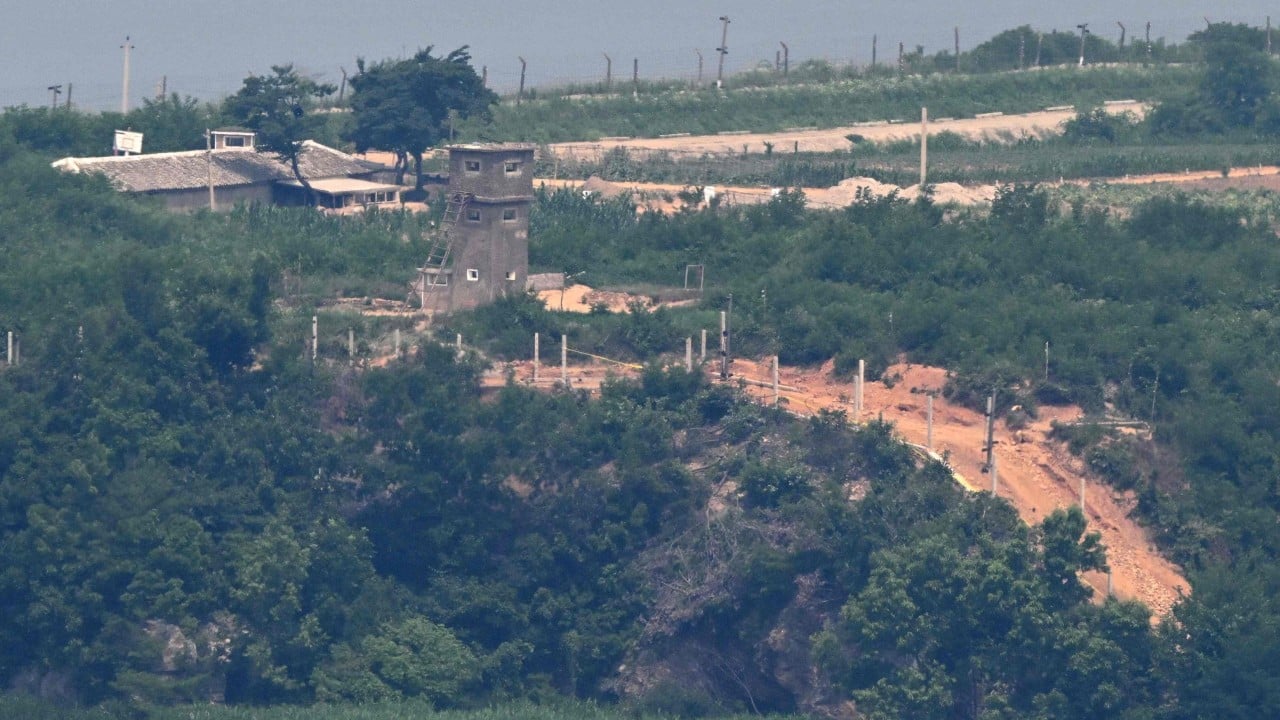
Fog does not roll softly across the Demilitarized Zone. It clings to the razor wire like a wet shroud, obscuring the watchtowers where young men stare into binoculars, waiting for an invisible spark.
On maps, the border dividing the Korean Peninsula is drawn with a clean, red line. On the ground, it is a graveyard of rusted iron, hidden explosives, and a terrifying vacuum of sound. When the red telephones on either side of the Military Demarcation Line went dead, the silence did not bring peace. It brought something far more dangerous. It brought guesswork.
Consider what happens when two neighbors sharing a combustible yard stop speaking entirely. If a branch falls across the fence in the dark, one assumes it is an act of aggression. The other assumes it is a maintenance failure. Without a quick word across the hedge, shovels turn into rifles, and rifles turn into shrapnel.
Recent explosions along this militarized frontier—where landmines have torn through the earth and the bodies of those tasked with fortifying the dividing line—reveal a stark, unyielding truth. When communication channels are severed, tragedy is no longer a risk. It is a mathematical certainty.
The Anatomy of an Unspoken War
To understand why a severed telephone cable can precipitate a crisis, one must look at how the border has evolved from a ceasefire line into a heavily fortified scar. Established in the wake of the armistice that halted active combat in nineteen fifty-three, the DMZ spans two hundred and fifty kilometers across the peninsula. It is four kilometers wide, a strip of land that nature has reclaimed in patches of tall grass and dense thicket, even as humanity weaponized every inch beneath the soil.
For decades, maintaining this volatile peace relied heavily on mechanical redundancy. Hotlines were installed—some in underground bunkers, others in prefabricated buildings at Panmunjom. These were not symbols of friendship. They were panic buttons. They were designed for the midnight hour when a patrol strayed fifty meters off course in a blinding snowstorm, or when an accidental artillery discharge echoed across the valley. A voice on the other end could say: Hold your fire. It was a mistake.
That safety valve is gone.
North Korea's systematic severing of cross-border communication lines—followed by the physical destruction of roads, rail links, and now the grim, daily reality of border mine blasts—has left both sides operating in a sensory deprivation chamber. Soldiers are no longer just separated by a border; they are separated by total informational darkness.
Imagine standing in a concrete guardpost on a freezing November evening. The wind howls off the mountains. Suddenly, a muffled thud vibrates through the floorboards. A mine has detonated down the line. Was it a wild animal triggering an aging, half-century-old explosive left over from the war? Was it a sapper laying new mines under direct orders? Or was it an accident by a cold, disoriented conscript?
In the past, a commander could lift a receiver, dial a familiar extension, and ask. Today, that commander lifts the receiver to absolute, dead air. In that silence, doctrine takes over. Doctrine does not tolerate ambiguity. Doctrine demands a response.
The Weight of the Iron Wall
The physical restructuring of the border mirrors the psychological hardening of the regimes. Concrete walls rise where paved roads once ran. Barbed wire stretches higher into the grey sky. Landmines, once buried as static deterrents, are being planted anew in frantic efforts to seal the frontier completely.
This is not defense. This is isolation by design.
Behind these barriers lies a profound human cost. On both sides of the line, young men and women spend their formative years watching a strip of dirt through gun sights. They are conditioned to expect the worst. When communication exists, even between bitter adversaries, it injects a dose of humanity into the machinery of statecraft. It reminds the commanders that there are breathing human beings on the other side of the ridge.
Without it, the enemy becomes a ghost story. And ghosts do not negotiate. They do not accept explanations. They must be struck first, before they strike you.
The recent mine blasts underscore the volatility of this environment. Laying mines in a frozen, sloping terrain is treacherous work. Soldiers slip; detonators fail; mistakes compound. When an explosion occurs without explanation or immediate context, the military apparatus across the trench does not wait for an investigation. They interpret the tremor through the lens of worst-case scenarios.
History offers grim instruction on what happens when communication breaks down entirely. The twentieth century is littered with crises that escalated not because leaders wanted war, but because they lost the ability to tell each other they didn't. The hotlines of the Cold War were born from the terror of the Cuban Missile Crisis—a recognition that when seconds count, shouting across an ocean or a border is an invitation to catastrophe.
The Cost of Mutual Blindness
There is a grim irony in the current state of affairs. While technology connects ordinary citizens across the globe in milliseconds through fiber optics and satellite relays, the two Koreas are technologically regressing at their shared border, relying on physical walls and total radio silence.
The absence of dialogue breeds a dangerous arms race of perception. Every movement by one side is magnified, scrutinized, and misread by the other. If a patrol vehicle moves an inch too close to the demarcation line, it is no longer viewed as a routine deployment; it is cataloged as a prelude to an assault.
This hyper-vigilance creates a hair-trigger environment where a single errant flare or a startled animal can cascade into an exchange of fire. And because the verbal bridges have been burned, there is no off-ramp. Once the shooting starts, how does it stop? Without a telephone to ask for a ceasefire, escalation feeds on its own momentum.
Restoring communication is not an act of political concession. It is not a reward handed to an adversary. It is a basic survival mechanism. It is the installation of smoke detectors in a powder keg.
Until those lines are reconnected—until a voice from the south can speak plainly to a voice in the north when the earth shakes in the night—the peninsula remains suspended over an abyss. The mines in the soil will continue to claim limbs and lives, but the greater danger lies in the mines planted inside the minds of the men holding the triggers, operating in the dark, waiting for a war that nobody wants yet everyone is preparing to fight.
The wind howls through the valley once more. A flare arcs across the black sky, illuminating the razor wire in a sickly, green glare. Down in the bunker, the red phone sits in the dust, its cord severed, waiting for a ring that will not come.