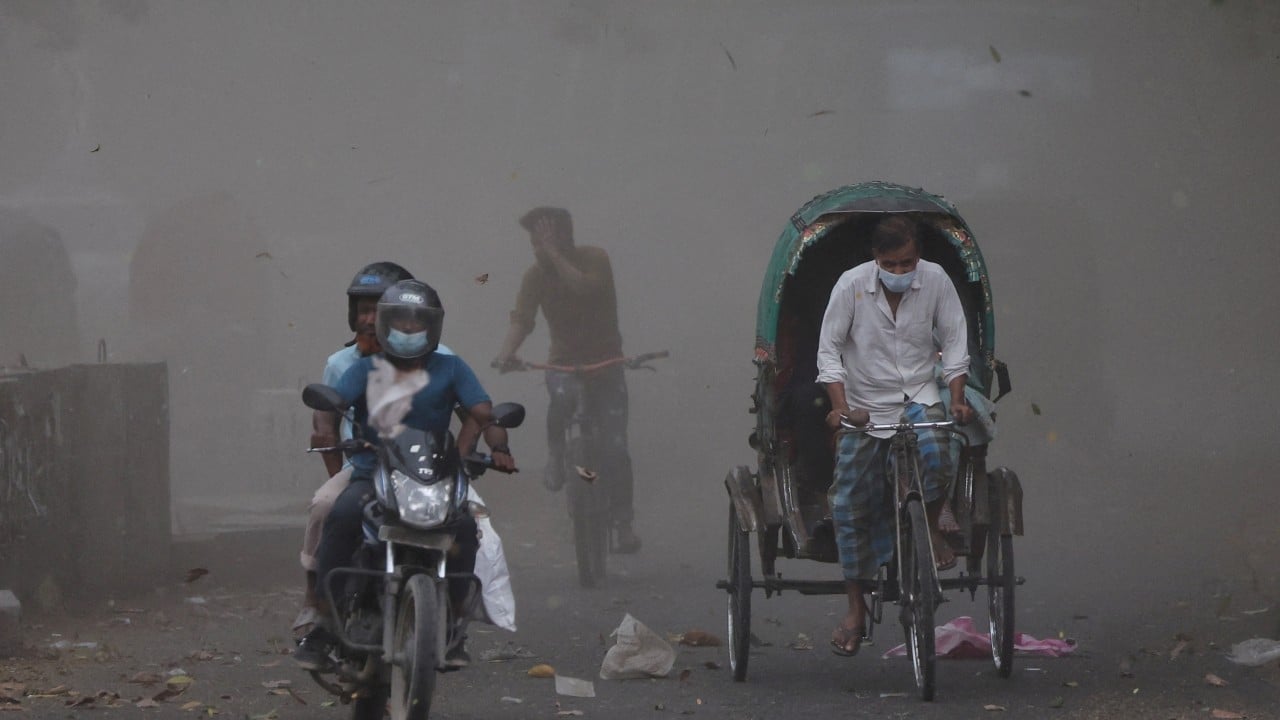
The air in rural Bangladesh does not just sit; it breathes. In the moments before a pre-monsoon storm, that breath turns heavy, smelling of ozone and wet earth. It is a thick, expectant silence that the locals know well. For Abdul, a hypothetical but representative farmer in the Sunamganj wetlands, this heavy air usually signals the arrival of life-giving water for his rice paddies. But lately, the clouds have brought something else.
They brought fire from a clear blue height.
In a single twenty-four-hour window, the geography of grief expanded across the nation. Fourteen lives were extinguished. Not by flood, not by famine, but by the instantaneous, searing precision of lightning. To read the headlines is to see a statistic. To stand in the mud of a village like Jamalpur or Sylhet is to realize that a statistic is just a skeleton of a much more haunting reality.
The Electric Lottery
Lightning is the most democratic of killers. It does not care for borders or bank accounts, yet in the delta of Bangladesh, it has developed a cruel preference for the vulnerable.
Most of the fourteen victims were doing exactly what their ancestors have done for a thousand years. They were tending crops. They were hauling nets. They were walking home. When the sky fractured, there was no siren. There was no shelter. In the open expanses of the haors—the vast seasonal wetlands—a human being is often the tallest object for miles.
Physics is indifferent to a father’s need to finish the harvest.
Consider the mechanics of the strike. A bolt of lightning can heat the air around it to 30,000°C. That is five times hotter than the surface of the sun. When that energy meets a human body, it doesn't just burn. It short-circuits the very electricity that keeps the heart beating. It is a total system failure.
Why the Toll is Rising
We used to call these "acts of God." Now, we have to look at the thermostat.
Scientists have noted a terrifyingly simple correlation: as the atmosphere warms, it holds more moisture and more energy. This creates the perfect laboratory for "super-cell" storms. For every degree of global warming, the frequency of lightning strikes is predicted to jump by about 12%.
But there is a quieter, more terrestrial reason for the mounting body count.
Decades ago, the Bangladeshi countryside was dotted with towering palm and coconut trees. These acted as natural lightning rods, intercepting the high-voltage reach of the clouds before it could find a human target. As the population surged and land became more valuable, these trees were felled for timber or to make room for more intensive farming.
We traded our shields for a few extra feet of soil.
Now, when a storm rolls in over the flat plains of Netrokona or Chittagong, the electricity searches for a path to the ground. Without the palms, the farmer in the field becomes the path.
The Anatomy of a Stormy Afternoon
Imagine the sequence of events. It is early afternoon. The heat is stifling, reaching 36°C. You are working in a knee-deep paddy, the water reflecting a sky that has turned a bruised shade of purple. You hear the rumble. It’s far off, or so it seems.
This is the "Bolt from the Blue" phenomenon. Lightning can travel horizontally for miles before darting down to earth. You think you are safe because the rain hasn't started. You think you have ten more minutes to finish this row of seedlings.
Then, the hair on your arms begins to stand up.
Your skin tingles.
In that microsecond, the ground beneath you is reaching up to meet the charge descending from the clouds. If you are standing in water, you are essentially part of the circuit.
For the families of the fourteen who died this week, there was no "Imagine." There was only the flash, the thunder that felt like a physical blow, and then the silence. In one household, a mother was preparing a meal. In another, a young boy was playing near a pond. In an instant, the structure of those families was permanently altered.
The Myth of the Rubber Sole
There is a common misconception that wearing rubber boots or being inside a car with rubber tires will save you. It is a comforting thought. It is also wrong.
A bolt of lightning that has just traveled through miles of air—one of the world's best insulators—is not going to be stopped by half an inch of rubber. If you are in a car, you are safe because the metal frame acts as a Faraday cage, conducting the electricity around you and into the ground. If you are in a field with rubber boots, you are simply a grounded target with slightly drier feet.
The real problem lies in our infrastructure. In the West, lightning protection is baked into the architecture. Every skyscraper, every school, and many homes have rods that bleed off the atmospheric charge. In rural Bangladesh, the "architecture" is often a tin-roofed hut.
A tin roof during a lightning storm isn't a shelter. It’s a conductor.
The Invisible Stakes
When fourteen people die in a day, the economic shockwave is as devastating as the physical one. These victims are almost always the primary breadwinners.
When a farmer dies in the field, the rice doesn't get harvested. The debt to the seed merchant doesn't get paid. The children are pulled out of school to work the land. One lightning strike can trigger a cycle of poverty that lasts for three generations.
This is why the government has begun to classify lightning as a natural disaster on par with cyclones and floods. It is a recognition that this isn't just "bad luck." It is a public health crisis fueled by a changing climate and a deforested landscape.
Finding the Shield Again
Is there a way back?
There is a movement growing in the villages. It’s a slow, green revolution. The government has begun planting millions of palm trees across the most at-risk districts. It is a long-term play—trees take years to grow tall enough to be effective—but it is a return to a wisdom we should never have abandoned.
There are also the "lightning sheds." These are simple concrete structures with lightning rods, built in the middle of vast fields to give workers a place to run when the air starts to hum.
But the most important tool is education.
People are being taught the "30-30 Rule." If you see lightning, count the seconds until you hear thunder. If it’s less than thirty, the storm is close enough to hit you. Then, stay indoors for thirty minutes after the last clap of thunder.
It sounds simple. But when your survival depends on the work you do in the next hour, "staying indoors" is a luxury many feel they cannot afford.
The Weight of the Sky
The tragedy of the fourteen isn't just in their deaths. It’s in the realization that as our world gets hotter and our fields get emptier, the sky is becoming a place of danger rather than a source of life.
We often talk about the "environment" as something far away—melting ice caps or dying coral reefs. But in Bangladesh, the environment is the thing that hits you while you are trying to feed your family. It is intimate. It is immediate.
The next time the sky turns that specific shade of bruised purple, the people of the wetlands will look up. They will feel the hair rise on their arms. They will remember the fourteen. And they will have to decide if the rice in the mud is worth the fire in the clouds.
The air remains heavy. The season has only just begun.
Somewhere in a field in Sylhet, a man drops his tools and starts to run toward a distant, solitary tree, hoping it is tall enough to speak to the lightning so he doesn't have to.