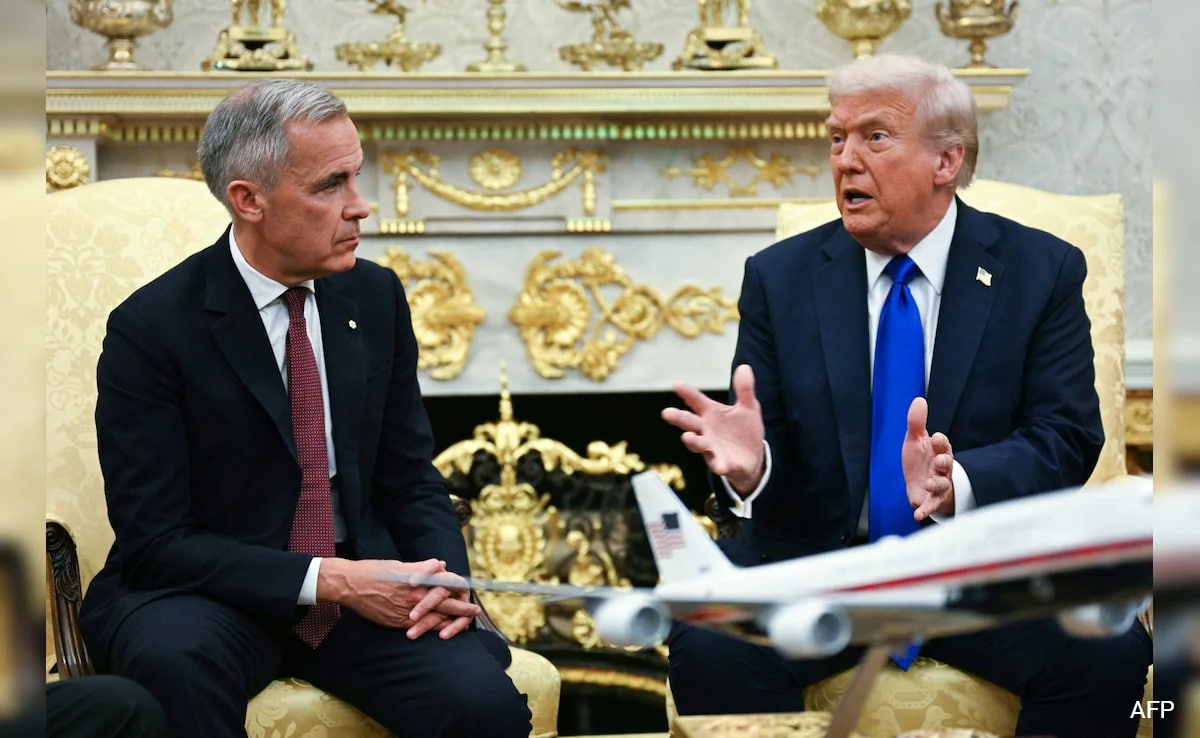
Canada’s historical economic strategy—predicated on frictionless access to the United States market and a shared commitment to multilateral trade—is no longer a hedge against global volatility; it has become a primary source of systemic risk. The recent assertions by Mark Carney regarding the inversion of Canadian strengths into weaknesses reflect a fundamental misalignment between 20th-century institutional inertia and 21st-century geoeconomic realities. As the United States pivots toward aggressive industrial policy and protectionist "friend-shoring," the passive integration model that once fueled Canadian prosperity now exposes deep structural vulnerabilities in productivity, energy transition, and sovereign agency.
The Trilemma of Canadian Economic Dependence
The current friction in the Canada-US relationship is not merely a diplomatic hurdle but a failure of the Continental Integration Thesis. This thesis rested on three pillars that have simultaneously fractured.
1. The Erosion of the Reciprocal Border
For decades, the Canada-US border functioned as a low-friction conduit for integrated supply chains, particularly in the automotive and aerospace sectors. The logic was simple: geographic proximity and regulatory alignment created a "borderless" manufacturing zone. This strength has inverted. The US transition toward the Inflation Reduction Act (IRA) and the CHIPS Act signals a move from "free trade" to "managed trade." Canada now faces a cost-of-competition crisis. When the US subsidizes domestic production, Canada's relative lack of fiscal scale means it must either match these subsidies—straining the national deficit—or watch its industrial base hollow out as capital flows south toward higher-incentive environments.
2. The Commodity-Currency Trap
Canada’s status as a resource superpower was a guaranteed win when global demand was linear and carbon-blind. Today, the energy transition has bifurcated the value of Canadian exports. While the US remains the primary consumer of Canadian oil and gas, it is also becoming a direct competitor in global LNG markets. This creates a strategic bottleneck. Canada is locked into a single-buyer relationship with a neighbor that is increasingly self-sufficient. The "strength" of having a massive energy customer has become a "weakness" of market concentration, leaving Canada with zero price-setting power and high exposure to US regulatory shifts.
3. Institutional Complacency and the Productivity Gap
The security of the US umbrella—both military and economic—allowed Canadian policymakers to deprioritize domestic R&D and business investment. This led to a chronic productivity gap. Canadian business investment per worker is roughly 50% of the level seen in the United States. While the US economy thrives on "creative destruction" and high-risk venture capital, the Canadian system has optimized for "stable extraction." This stability is now a liability; when the US economy accelerates through technological disruption (AI, biotech, quantum), Canada’s laggard status becomes a permanent drag on the exchange rate and standard of living.
The Mechanism of Policy Decoupling
The divergence between Ottawa and Washington is driven by a shift in the US "National Security-Economic" nexus. The US no longer views trade through the lens of consumer efficiency; it views it through the lens of resilience and containment.
The Resilience Penalty
In a "Just-in-Time" world, Canada was the perfect partner. In a "Just-in-Case" world, the US is looking to internalize critical nodes of the value chain. Canada’s reliance on the USMCA framework assumes a level of rule-of-law stability that US domestic politics no longer guarantees. Every "Buy American" provision is a direct tax on Canadian specialized manufacturing. The cause-and-effect is clear: US domestic populism forces protectionist legislation, which disrupts the integrated supply chains Canada spent 40 years building, leading to a "Resilience Penalty" where Canadian firms must pay more to access the same markets or relocate operations entirely to the US to qualify for subsidies.
Quantifying the Opportunity Cost of Status Quo
To understand the severity of this shift, one must look at the Capital Allocation Inversion. Historically, US capital flowed into Canada to tap into resources and a stable workforce. Now, Canadian capital—specifically from pension funds and major banks—is flowing into the US to capture IRA-driven returns.
- Capital Flight: Large-scale Canadian institutional investors are increasingly overweight on US infrastructure and green energy projects because the "Return on Subsidy" in the US outperforms the "Return on Resource" in Canada.
- Labor Arbitrage: The "brain drain" has evolved into a "firm drain." Startups in the Toronto-Waterloo corridor or the Montreal AI hub often hit a ceiling where the cost of scaling in Canada, combined with the lack of deep-tier 2 and 3 capital, necessitates a flip to a US-headquartered model.
This creates a feedback loop. Lower domestic investment leads to lower productivity, which leads to a weaker CAD, which makes importing the technology needed to fix productivity more expensive.
The Three Pillars of a Sovereign Realignment
If the old strengths are now weaknesses, the solution is not a nostalgic attempt to revive the 1990s trade environment. It requires a hard pivot toward a Sovereign Resilience Framework.
Strategic Diversification of the "Criticals"
Canada must move beyond being a generalist resource exporter and become an indispensable node in specific, high-moat supply chains. This means moving from "selling raw lithium" to "controlling the mid-stream processing of battery-grade chemicals." By dominating a specific niche in the green transition that the US cannot easily replicate or "friend-shore" elsewhere (like Mexico or Vietnam), Canada regains leverage.
The Institutional Overhaul of R&D
The current Canadian SR&ED (Scientific Research and Experimental Development) tax credit system is fragmented and favors small-scale survival over large-scale commercialization. A rigorous strategy would consolidate these incentives into "National Missions" aligned with the energy transition and Arctic sovereignty. The goal is to create "sticky" IP that remains in Canada even as the manufacturing scales globally.
Arctic Sovereignty as Economic Leverage
The melting of the Northwest Passage is the most significant geopolitical shift in Canadian history. While the US and Russia eye these waters for transit and resources, Canada’s lack of maritime and surveillance infrastructure is a glaring vulnerability. Investing heavily in Arctic infrastructure is not just a defense play; it is the creation of a new global trade artery that Canada controls. This provides the ultimate hedge: if the southern border becomes too restricted, the northern corridor offers a direct link to Euro-Asian markets.
The Strategic Play
The path forward requires a brutal admission: the era of "Special Relationship" exceptionalism is over. Canada is now just another "friend" in a world where the US is increasingly transactional.
Strategic Action:
Canada must immediately implement a Reciprocal Industrial Policy. This does not mean a trade war, but it does mean mirroring US subsidies in high-growth sectors while simultaneously imposing "Resource Access Levies" on critical minerals exported to countries that exclude Canadian firms from their domestic subsidies.
The objective is to create a "Cost of Exclusion" for the United States. If the US wants access to the minerals and energy required for its own "Green Revolution," it must provide Canadian firms with full parity in its domestic incentive programs. Anything less is a managed decline of the Canadian middle class. The leverage exists, but the political will to use it as a blunt instrument of economic statecraft has yet to materialize.
Canada must stop behaving like a junior partner in a continental firm and start behaving like a sovereign entity in a competitive market. The transition from a "Passive Integrated Economy" to an "Active Sovereign Economy" is the only way to prevent the total erosion of the Canadian standard of living over the next decade.