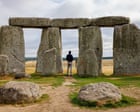
Dawn on Salisbury Plain arrives without fanfare. The chalk hills turn from ink to bruised violet, and then, slowly, into the pale, indifferent green of an English morning. Long before the ticket booths creak open and the red double-deckers discharge their cargo of rain-jacketed tourists, something stranger happens behind the security fences.
A heavy iron gate unlocks.
For most people, visiting the most famous prehistoric monument in Europe is an exercise in restraint. You walk the perimeter path. You keep your distance. You view the great sarsens from behind a modest rope barrier, separated from four thousand years of human ambition by twenty yards of crushed gravel and a polite queue. You take your photograph, you buy a postcard of a winter solstice sunrise in the gift shop, and you leave.
Unless you win the lottery.
Or, more accurately, unless you secure one of the tightly controlled, highly coveted passes that allow a small group of visitors to step past the ropes, walk down the grassy slope, and actually stand inside the circle.
Not for an afternoon. Not for an hour.
For exactly twenty minutes.
To understand why those twenty minutes matter, you have to abandon everything you think you know about how we visit ancient places. We treat history like a museum exhibit. We place glass between our fingers and the past. We view antiquity as a picture frame. But Stonehenge was never built to be looked at from a distance. It was built to be inhabited.
Consider what happens when you cross that invisible line.
The security warden—a quiet man with mud on his boots and a heavy brass ring of keys—locks the gate behind your small group. Suddenly, the distant roar of the A303 traffic fades into a dull hum, swallowed by the vastness of the sky. The stones, which look compact and orderly from the visitor center two miles away, suddenly loom thirty feet overhead. They are massive. They are scarred by lichen and weather. They bear the unmistakable signature of human labor: the precise, hollowed-out mortise holes and protruding tenons carved by Neolithic stonemasons using nothing more than hammerstones made of sarsen and flint.
You reach out. Your fingertips touch the cool, rough flank of a lintel stone.
That contact changes everything.
History stops being a textbook chapter. It becomes physical. You realize, with a sudden jolt of vertigo, that you are standing in the exact footfalls of people who lived four millenia before the invention of the compass, before the written word took root in Britain, before the first Roman galleys scraped against the Kentish coast. They dragged these fifty-ton blocks miles across the undulating chalk downs using plant-fiber ropes, wooden sledges, and sheer, collective stubbornness. They raised them into the air, slotted them together with woodworking joints executed in stone, and aligned them precisely with the summer solstice sunrise and the winter solstice sunset.
And then, the timer starts.
Twenty minutes.
It sounds like a generous window until you are actually inside. Time behaves strangely when you are sharing space with silence and megaliths. The first five minutes are spent in a mild state of sensory disorientation. People wander in different directions. Some drop to their knees to feel the turf. Others stand dead center in the horseshoe arrangement, tilting their heads back to watch rooks wheeling across the gray lintels. A few simply stand still, breathing in the damp scent of chalk and sheep manure, listening to the wind whistle through the uprights.
There are no audio guides blaring in your ears. There are no velvet ropes telling you where to tread. There is only the circular geometry of the stones and the ticking clock in the warden’s pocket.
By minute ten, the initial rush of adrenaline settles into something more contemplative. You notice the tooling marks on stone number fifty-three. You see how the outer circle acts as a massive natural amphitheater, dampening the outside world while amplifying the sound of your own boots on the turf. You begin to understand the architectural theater of the place. It was designed to overwhelm the senses, to make the individual feel small against the sweep of the cosmos, yet paradoxically connected to the community that built it.
This is the hidden value of the managed access pass. English Heritage allows these intimate visits outside of regular opening hours specifically to preserve that fragile connection. During peak daytime hours, the monument is a spectacle. During the dawn or dusk access slots, it becomes a sanctuary.
Yet, human nature being what it is, the twenty-minute limit introduces a peculiar brand of anxiety.
You watch couples frantically trying to take selfies that capture both their faces and the altar stone. You see history enthusiasts measuring gaps with stride lengths. You hear whispered arguments about whether the bluestones came from the Preseli Hills in Wales via human transport or glacial drift—a debate that has occupied archaeologists for a century, compressed here into a frantic thirty-second chat while checking a wristwatch.
The artificial scarcity of time forces an evaluation of what we actually want from heritage tourism. Do we want accumulation—more sites checked off a list, more photos banked in the cloud? Or do we want resonance?
By minute eighteen, the anxiety usually breaks. People stop trying to capture the experience and simply surrender to it. The cameras drop to sides. Silence takes over the inner circle.
Then, the key turns in the padlock.
The warden clears his throat gently. "Time's up, folks."
There is an audible collective sigh. You turn away from the sarsens, walk back up the gentle slope, and step through the gate. The iron bar drops back into place with a heavy, final thud.
Outside the fence, the first tour buses of the morning are rumbling into the car park. The gift shop is opening its shutters. The audio guides are being charged in their racks. Within minutes, the rope barriers will fill with thousands of eager faces, all looking inward from the outside, separated from the magic circle by twenty yards of gravel and an invisible boundary.
You walk back toward the visitor center with dirt on your shoes and cold fingers. You realize you didn't learn any new archaeological breakthroughs during those twenty minutes. You didn't solve the mystery of why the builders hauled stones across two hundred miles of Welsh wilderness.
Instead, you learned something far rarer. You learned what it feels like to stand briefly, quietly, inside the heartbeat of the past before the world wakes up and demands you keep moving.