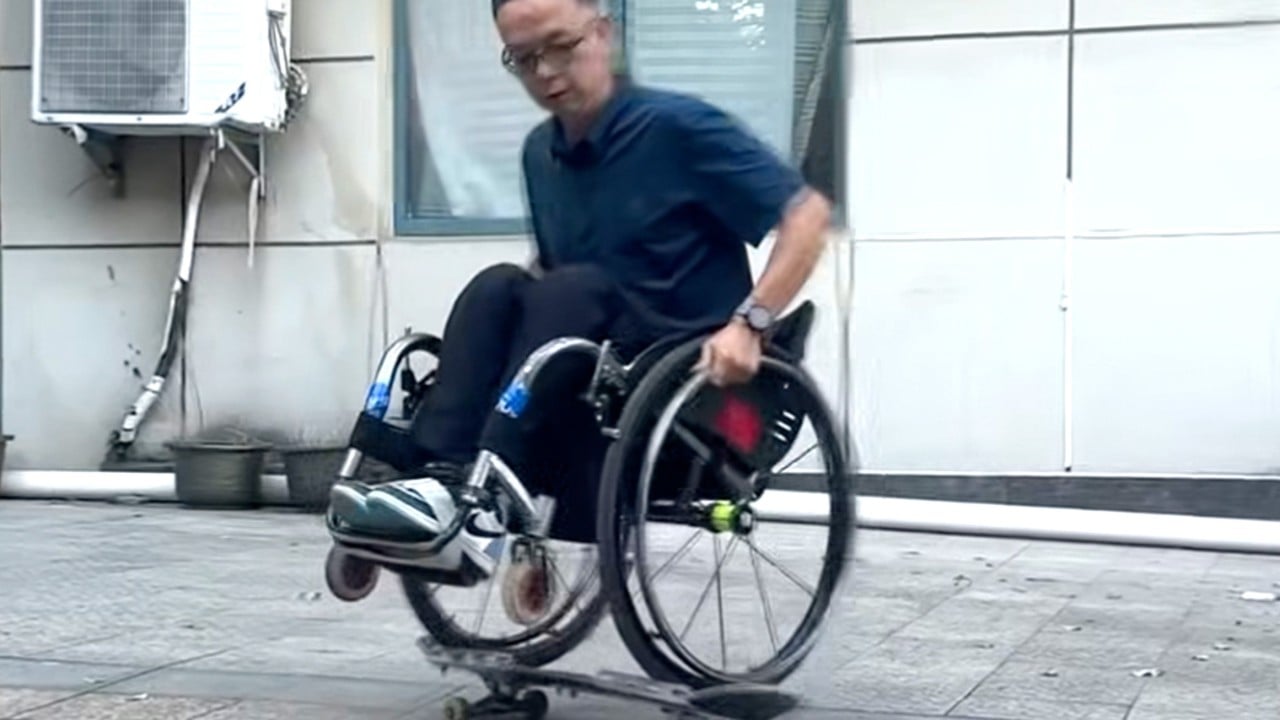
Propelling a skateboard with the upper limbs while balancing the entire body mass on the hands flips human locomotion upside down, turning evolutionary optimization on its head and exposing the raw mechanics of torque, grip, and kinetic transfer. This analysis deconstructs viral hand-skateboarding spectacles—such as those attributed to a Chinese world record holder in the reference headline—into an engineering and biomechanics model. Rather than treating hand-skateboarding as a quirky novelty act, the framework below separates verified physical principles from educated hypotheses, maps the exact cause-and-effect chains that make or break a run, and evaluates how performance translates across surfaces, boards, and training regimes.
The Biomechanics of Upper-Limb Locomotion on a Mobile Deck
Standard bipedal skateboarding relies on the lower extremities to absorb shock, modulate center of mass (CoM) height, and apply rotational torque through the hips and ankles. Hand-skateboarding transfers every one of those duties to the shoulder girdle, elbows, wrists, and hands while placing the CoM much closer to the deck surface—a trade-off that changes stability dynamics before a single push occurs.
Load Transfer and Joint Vulnerability
Human upper limbs evolved primarily for reach, manipulation, and intermittent support rather than sustained weight-bearing and repetitive ground-reaction forces. When an athlete supports full body weight on the hands over a rolling platform, three mechanical realities govern joint safety and force output:
- Wrist extension limits: Maximum dorsiflexion angles restrict how far forward the CoM can travel before torque exceeds passive ligamentous restraint.
- Scapulothoracic stability: Without a rigid pelvic ring to anchor the limbs, force transmission depends on serratus anterior, trapezius, and rotator cuff co-contraction.
- Elbow locking versus micro-flexion: Full extension reduces muscular demand momentarily but spikes impact shock into cartilage and subchondral bone upon landing or hitting pavement seams.
- Grip and contact friction: Skin-to-grip-tape or palm-to-pavement friction dictates whether horizontal push forces convert into forward board acceleration or slip.
A clear boundary separates established biomechanics from educated hypotheses regarding extreme viral clips. It is a known biomechanical fact that the shoulder joint sacrifices bony congruence for range of motion, making dynamic muscular stabilization indispensable under high loads. It is a known physics principle that lowering the CoM reduces the moment arm of gravitational toppling torque for a given lateral acceleration, though it also compresses the vertical distance available to absorb impact via joint flexion. By contrast, when a viral headline cites a "world record holder" performing hand-skateboarding without specifying the governing body, event rules, distance, time, or trick criteria, the exact record parameters remain an educated hypothesis inferred from standard speed or endurance formats rather than verified raw data.
Propulsion Mechanics Without Foot-Pushing
On a conventional skateboard, a rider plants one foot on the ground and pushes backward to generate impulse, or pumps across transition terrain by shifting weight and extending knees to convert potential and centrifugal energy into speed. On the hands, propulsion follows a tighter geometric envelope.
Push strokes on flat ground require either planting one hand on the pavement while the supporting hand stabilizes the deck—a high-shear maneuver that risks skin abrasion and shoulder rotation—or oscillating weight shifts and upper-body extension across the board's length. Because arm reach is shorter than leg stride length, each stroke covers less ground and requires higher cadence or superior timing to maintain momentum.
Consider a concrete example of an athlete rolling down a gentle incline on their hands. As board speed rises, aerodynamic drag and bearing/wheel rolling resistance increase nonlinearly, while the athlete's hands must continuously damp micro-vibrations from aggregate texture. If the athlete tries to steer hard using a single hand while the other stays planted or gripping the rail, asymmetric torque can twist the deck out from under the supporting palm unless core anti-rotation muscles lock the torso into a single rigid beam.
The Three Pillars of Hand-Skateboarding Performance
To move beyond surface amazement and evaluate why certain athletes succeed while others bail out immediately, performance can be organized into three interlocking pillars: Structural Force Readiness, Dynamic Balance Control, and Equipment-Surface Coupling. Weakness in any single pillar caps total capability regardless of how impressive the other two look on video.
Structural Force Readiness
Structural readiness determines how much mechanical load the athlete's musculoskeletal system can tolerate repeatedly without tissue failure or form breakdown. Pushing muscles (pectorals, anterior deltoids, triceps) generate extension and pressing force, while pulling and scapular muscles (latissimus dorsi, rhomboids, lower trapezius, posterior deltoids) control deceleration and shoulder centering.
A common failure mode in self-taught hand-balancing is over-indexing on pressing strength while neglecting scapular depression and thoracic mobility. When thoracic extension is stiff, shifting weight forward over the hands forces excessive lumbar hyperextension or jams the anterior shoulder capsule. Over dozens of runs or long distance attempts, cumulative micro-trauma shifts from a training stimulus to an overuse bottleneck.
Dynamic Balance Control
Balance on a skateboard is never static; it is a continuous feedback loop between visual and vestibular sensors, proprioception, and motor corrections. Because a skateboard rolls freely along its wheel axis and tilts along its truck axis, the athlete manages two coupled degrees of freedom simultaneously.
Pitch control (front-to-back balance) governs acceleration and deceleration relative to the deck. Roll control (side-to-side balance) governs carving, turning, and resistance to camber or crosswinds. When hands are planted on the board, small corrections in finger pressure and forearm pronation/supination alter truck lean—provided the hands maintain firm positional coupling with the deck rather than sliding.
Equipment-Surface Coupling
Hardware choices either amplify or punish upper-limb control. A wider deck offers more lateral real estate for hand placement and slightly greater leverage over the trucks, yet it adds rotational inertia and weight. Harder durometer urethane wheels roll faster on smooth concrete with less energy loss, whereas softer wheels absorb rough asphalt cracks at the cost of higher rolling resistance.
Truck tightness plays an outsized role under hand weight. Loose trucks allow nimble carving and rapid directional shifts, but they can induce speed wobble or sudden dive when an athlete's weight shifts unevenly during a push stroke. Tighter trucks damp erratic wobble, yet they demand greater torque input to initiate turns smoothly.
Cause-and-Effect Chains Standard Coverage Misses
Viral articles typically jump straight from "he moves fast on his hands" to "he has incredible balance and strength." That shortcut skips the causal mechanisms that explain both the spectacle and its hidden costs.
Why Speed Changes Balance Geometry
Increasing forward speed on a skateboard does not simply make balance harder; it alters the physics of stability. Gyroscopic precession from spinning wheels is tiny compared to human mass effects, so the primary shift comes from momentum and ground interaction. At higher speed, any obstacle—a pebble, expansion joint, or crack—delivers a sharper impulse over a shorter time window. Because the athlete's head and eyes sit lower than in upright skating, the visual horizon rushes past faster and optical flow increases, requiring rapid visuomotor processing to spot hazards early enough to adjust hand position or bail cleanly.
The Fatigue-to-Error Cascade
In endurance or repeat-attempt hand-skateboarding, fatigue rarely announces itself first as a dramatic muscle cramp. The first casualty is fine motor precision. As forearm flexors, wrist stabilizers, and shoulder stabilizers accumulate metabolic fatigue, small stabilization adjustments become delayed or oversized.
This creates a chain reaction: delayed hand micro-corrections allow the board to drift slightly off line; correcting the drift requires a larger postural shift; the larger shift taxes core and shoulder stabilizers further; and at the moment a sudden bump arrives, fatigued musculature lacks the rapid stiffness needed to absorb the spike. Most high-consequence bails occur late in a session or sequence rather than on the first fresh attempt.
Surface Friction vs. Skin and Joint Shear
Pavement is unforgiving. Grip tape provides high friction against rubber shoes, but against bare skin or thin gloves, high friction can cause immediate shear blisters or avulsions if a hand slips under load. Conversely, low-friction surfaces or wet patches remove traction just when a bracing hand needs to arrest a fall.
The second limitation involves bail mechanics. Upright skaters step off the board and run out of momentum or tuck into a shoulder roll. A hand-skater already has their hands near the ground, which can look convenient for catching a fall—until forward velocity makes a straight-arm catch dangerous for wrists, elbows, and clavicles. Knowing how to collapse safely onto a broader surface or roll out of momentum is a critical risk-control variable that highlight reels edit out.
How to Train and Evaluate Hand-Skateboarding Safely
Anyone looking to build hand-skateboarding competence—or assess a viral clip with a critical eye—can follow a structured progression that prioritizes joint longevity and controllable variables over spectacle.
- Audit baseline joint capacity first: Verify pain-free wrist extension under load, controlled scapular push-ups, hollow-body core tension, and overhead/floor shoulder stability before adding rolling instability.
- Separate static balance from rolling motion: Practice hand-balancing and weight shifts on a stationary deck placed on carpet or grass first so pitch and roll control can be felt without wheel travel.
- Start on smooth, low-traffic, flat terrain: Choose freshly poured concrete or smooth plaza surfaces with minimal debris and zero steep grades to keep speeds predictable while learning push-and-glide rhythm.
- Calibrate hardware conservatively: Use medium-to-tight trucks initially to prevent unwanted dive, medium-soft wheels for forgiving roll over minor imperfections, and protective wrist/palm gear during early skill acquisition.
- Cap volume and monitor movement quality: End a session the moment scapular shrug, wrist discomfort, or sloppy hand placement appears, treating technical cleanliness as the stopping rule rather than arbitrary clock time.
These steps carry clear operational trade-offs. Protective gear reduces skin and wrist impact risk, yet bulky wrist guards can restrict dorsiflexion angles needed for certain hand positions or alter tactile feedback on the deck. Similarly, training exclusively on ultra-smooth flat ground builds clean mechanics quickly, but it will not prepare an athlete for rough asphalt or transitions without gradual exposure. There is no universal training shortcut that bypasses gradual connective-tissue adaptation.
Evaluating Viral Claims Against Real-World Constraints
When a video claims a world record or extraordinary feat in hand-skateboarding, disciplined analysis checks four variables before accepting the framing: verified measurement standards (timed sprint, longest distance, longest duration, or specific trick catalog), environmental conditions (decline grade, wind, surface smoothness, pushed vs. towed momentum), biomechanical repeatability (a single lucky clip versus consistent execution), and risk exposure (unprotected public streets versus controlled environments).
In competitive action sports and human-performance media, attention naturally gravitates toward extreme outliers. Yet sustainable excellence—whether in an athlete's training block or a media brand's coverage—comes from measuring the underlying mechanics rather than chasing novelty alone.
For athletes and coaches building upper-limb locomotion programs, the decisive strategic move is to treat hand-skateboarding as an advanced motor-control and load-tolerance discipline anchored by structured scapular and wrist conditioning, progressive surface difficulty, and strict session stop-rules—never as a rushed attempt to replicate a viral clip on public pavement.