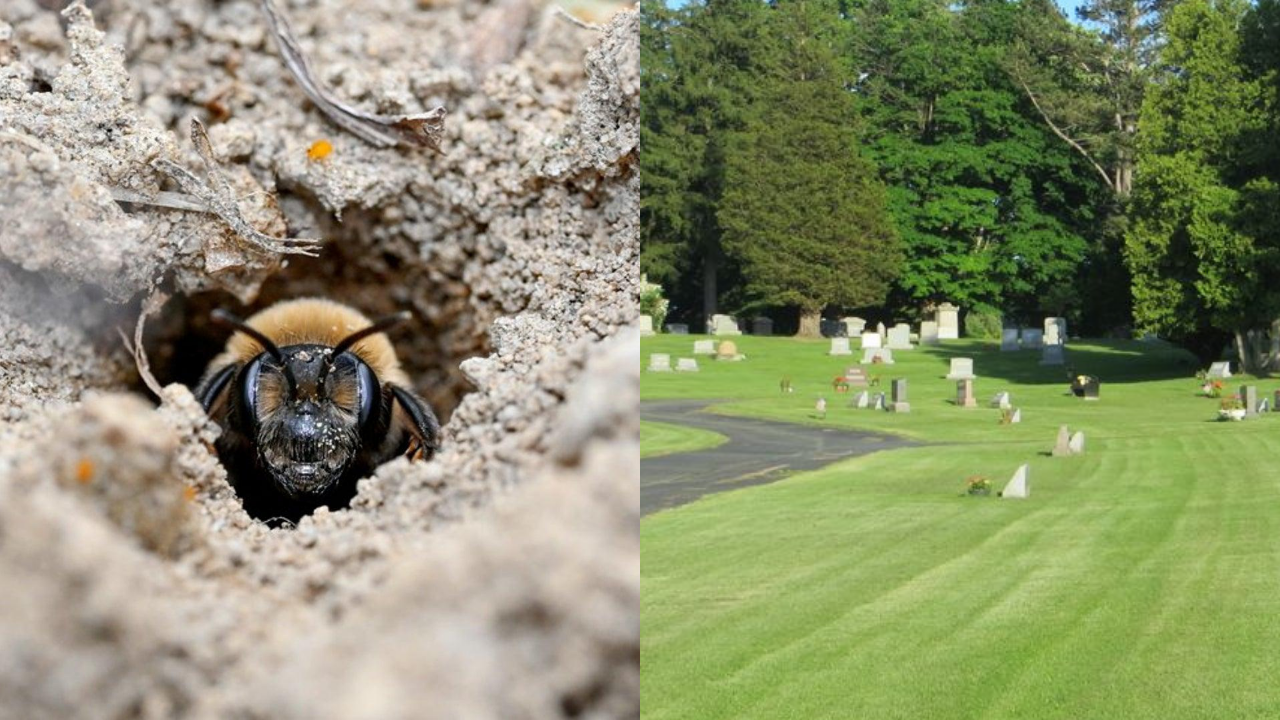
You probably think you know what a bee colony looks like. A structured wooden box, a buzzing swarm, and a single queen ruling over thousands of loyal workers. But you're missing the real story of America's native pollinators. Most of our bees don't live in hives. They don't make honey, they don't have queens, and they spend their entire lives buried in the dirt right beneath our feet.
We've been looking in the wrong places to save them.
A massive discovery at East Lawn Cemetery in Ithaca, New York, proves exactly how wrong we've been. Researchers found an estimated 5.5 million ground-nesting bees thriving right under the cemetery turf. This isn't a recent migration. Evidence shows this massive underground metropolis has been active for over a century. It's one of the largest wild bee aggregations ever documented, and it completely changes how we think about urban conservation.
If we want to stop the decline of native pollinators, we need to stop obsessing over backyard honeybee hives and start looking at where dead bodies are buried.
The Secret Underground Metropolis in Ithaca
The discovery didn't happen during a massive, high-funded expedition. It started with a routine commute. In the spring of 2022, Rachel Fordyce, a researcher walking through the grounds of East Lawn Cemetery on her way to a Cornell University entomology lab, noticed the ground was practically alive with activity. Small, dark bees were emerging from thousands of tiny holes in the soil.
She bagged a few specimens and brought them to Bryan Danforth, a professor of entomology at Cornell. The diagnosis came back quickly. They were Andrena regularis, commonly known as the regular mining bee.
To map out exactly what was happening under the grass, a research team led by Steve Hoge placed specialized mesh traps across the cemetery grounds between March and May. What they found blew past everyone's expectations. The data revealed an average density that translates to roughly 5.5 million bees packed into just 1.5 acres of land.
To put that into perspective, that single plot of land holds more individual bees than the human population of Manhattan multiplied by three. It's the biomass equivalent of managing over 200 commercial honeybee hives, all operating silently beneath a manicured lawn without anyone noticing.
Why Mining Bees Choose Cemeteries Over Farmland
To understand why these insects chose a cemetery, you have to look at the biology of a solitary bee. Unlike imported European honeybees, mining bees are fiercely independent. Every single female digs her own private tunnel into the earth, creates individual chambers, fills them with pollen, and lays her eggs. They don't share responsibilities, and they don't defend a central hive.
However, they love neighbors. If the conditions are perfect, millions of solitary females will build their private burrows right next to each other.
East Lawn Cemetery happens to offer the ultimate real estate for a mining bee colony.
- Undisturbed Soil: The cemetery was established in 1878. Once a plot is mapped out or filled, the soil stays put. Agricultural lands get tilled every year, which completely destroys underground burrows.
- The Perfect Texture: Mining bees require well-drained, sandy soil that is easy to excavate but won't collapse during a heavy rainstorm. The geological makeup of this specific Ithaca hillside fits the bill perfectly.
- Zero Chemicals: Modern corporate landscaping loves heavy pesticides and weed killers. Older, nonprofit, or historic cemeteries tend to use far fewer chemical treatments on their expansive lawns, creating a safe zone free from toxic runoff.
Historical records show these specific bees have been logged at East Lawn since the early 1900s. They survived urbanization, changing climates, and a century of human history simply because the ground above them remained sacred and untouched.
The Massive Agricultural Impact Hidden in Plain Sight
This isn't just a cool story for insect nerds. It's a massive financial and ecological deal for local food production.
The East Lawn site sits just about a third of a mile away from the famous Cornell Orchards. Every spring, thousands of apple trees need massive amounts of pollination to produce New York's signature fruit crops. Honeybees get all the credit for this work, but they're actually incredibly inefficient compared to native species.
Mining bees have evolved a unique life cycle. They overwinter underground as fully formed adults. The moment the ground warms up in early April, they burst out of the soil. This emergence is perfectly timed to match the exact weeks when apple trees bloom.
Furthermore, native mining bees are tough. Honeybees are notoriously picky about weather, refusing to leave the hive if it's too cold, cloudy, or damp. Mining bees will fly in low temperatures and light drizzle, moving massive amounts of pollen when commercial hives are still shivering inside their boxes. The millions of bees living under East Lawn have likely been the primary engine driving the success of nearby fruit farms for decades.
The Problem With Our Current Bee Obsession
The media has spent years telling us to "save the bees" by setting up backyard honeybee hives. It's a well-meaning trend, but it's fundamentally flawed. Honeybees are essentially feathered livestock. They're domesticated, imported from Europe, and highly managed.
Flooding a local park or backyard with thousands of managed honeybees actually hurts the environment. They outcompete the vulnerable, native solitary bees for limited pollen and nectar resources.
Around 70% of the native bee species in the United States nest in the ground. They don't have a backup supply of honey to survive tough seasons. If a manicured park or a new housing development paves over their nesting grounds, that population vanishes instantly.
As Danforth noted during the study, if someone decides to pave over a 1.5-acre patch of cemetery lawn to build a new parking lot or a mausoleum, 5.5 million crucial pollinators die in an afternoon.
How to Turn Overlooked Spaces Into Pollinator Sanctuaries
The Ithaca discovery proves that cemeteries, old churchyards, and historic parks aren't dead spaces. They are vital, living biodiversity reserves. If a century-old cemetery can accidentally preserve millions of native pollinators, we can start doing it on purpose.
If you manage a public green space, a local cemetery, or even a large backyard, you can implement immediate changes to protect these hidden populations.
Stop Tilting at Windmills with Mowers
The supervisor of East Lawn Cemetery, Keven Morse, admitted that he always felt bad mowing certain sections where the bees migrated heavily in the spring. You don't need to stop mowing entirely, but raising the blade height during April and May protects the shallow entry tunnels of emerging bees.
Leave the Sandy Patches Alone
Property owners hate bare earth. We tend to throw down fertilizer, sod, and seed the second we see a patch of dirt. Don't do that. Native bees need exposed, sunny, sandy soil to dig their homes. Leave those thin, patchy areas of your lawn alone. They aren't ugly; they're essential infrastructure.
Map the Nesting Sites
The Cornell research team has launched a citizen science initiative called Project GNBee. They are asking everyday citizens to look for ground-nesting aggregations in their own neighborhoods. If you see thousands of tiny holes with small mounds of dirt resembling miniature volcanoes in the springtime, don't spray them with bug killer. Step back, take a photo, log the location, and make sure that patch of earth stays protected from heavy foot traffic and construction.
Protecting our food supply doesn't require complex technology or expensive corporate initiatives. It requires looking down, identifying the habitats that have already kept these insects alive for a hundred years, and leaving the dirt alone.