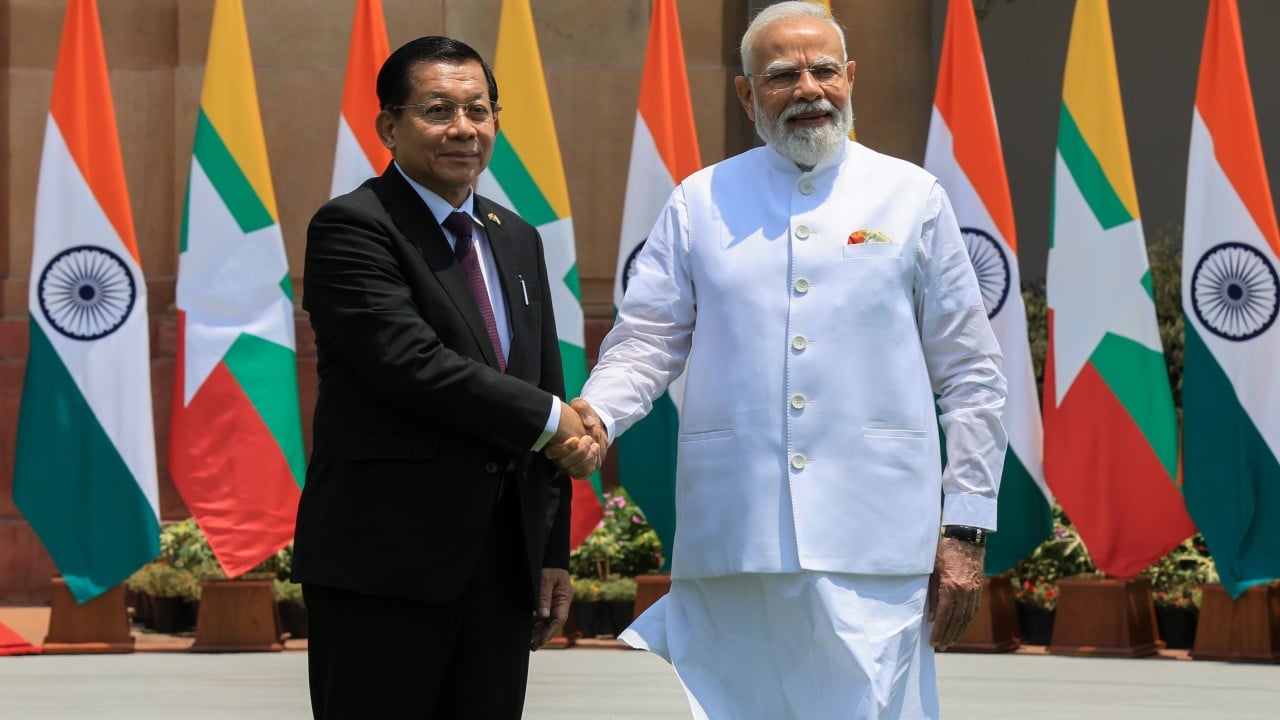
The international commentariat is having a collective meltdown over Myanmar President Min Aung Hlaing walking down a red carpet in New Delhi. Western think tanks and activist groups are frantically churning out the usual talking points, accusing India of compromising its democratic values and throwing a lifeline to a pariah regime. They look at the handshakes, the business forums, and the pilgrimage to Bodh Gaya, and they see a tragic moral compromise.
They are completely misreading the room.
The lazy consensus insists that India is making a desperate gamble, sacrificing its global standing just to spite China or protect a few stalled infrastructure projects. This narrative is comforting to people who view geopolitics as a morality play, but it bears zero resemblance to reality. New Delhi isn’t rolling out the welcome mat out of naive desperation or ideological alignment. It is executing a cold, calculated move based on hard-nosed survivalism and regional dominance.
If you think this visit is about legitimizing a junta, you are asking the wrong question entirely. The real question is: can any nation afford to ignore a 1,640-kilometer volatile border because the government on the other side doesn’t meet Western democratic standards?
The answer is an absolute no.
The Myth of the Moral Foreign Policy
Let's clear up a massive misunderstanding immediately. Foreign policy is not an exercise in ethics; it is an exercise in geography. Western nations have the luxury of cutting ties and slapping sanctions on Myanmar because they live thousands of miles away. Their borders are not being flooded with refugees, their territory is not being targeted by cross-border insurgent groups, and their supply chains do not rely on the stability of the Chindwin or Irrawaddy rivers.
India does not have that luxury.
When the West scolds New Delhi for hosting Min Aung Hlaing, they deliberately ignore the chaotic security dynamics of India's Northeast. Militancy-hit states like Nagaland and Manipur are powder kegs. For decades, insurgent groups have used the porous, forested border with Myanmar as a safe haven, striking Indian forces and then slipping back across the line.
I have seen intelligence analysts watch in horror as domestic political instability in a neighboring country directly translates into ethnic violence on Indian soil. Expecting New Delhi to halt security cooperation with the de facto authority in Naypyidaw is asking India to deliberately compromise its own territorial integrity.
The critics claim that by engaging with the newly structured civilian-clothed government, India is abandoning the democratic resistance. But let's look at the mechanics of the conflict. The resistance in Myanmar is not a unified, democratic army waiting to build a utopian state. It is a highly fractured patchwork of Ethnic Armed Organizations (EAOs) and People's Defence Forces (PDFs). Some of these groups are deeply entangled with drug trafficking, arms smuggling, and warlordism.
Imagine a scenario where India completely cuts off the central government in Naypyidaw. The border regions would not magically transform into democratic enclaves. Instead, the power vacuum would be filled instantly by a chaotic mix of armed militias, many of which have historical ties to Indian insurgent groups. New Delhi is choosing to deal with a centralized state actor because a centralized state—even a brutal one—is a predictable entity. An unpredictable, balkanized failed state on your eastern flank is a strategic nightmare.
The China Trap and the Fallacy of Neutrality
The second major pillar of the mainstream narrative is that India is panicking over China’s expanding footprint in Myanmar. The argument goes that Beijing has already won the race for influence, and New Delhi is merely picking up the crumbs.
This is structurally incorrect.
China’s relationship with Myanmar is incredibly transactional and deeply resented by the Burmese population. Beijing routinely plays both sides, funding the central government while simultaneously supplying weapons to ethnic militias along the Chinese border to maintain leverage. The Burmese military leadership is acutely aware of this double game. They don’t trust Beijing; they endure it because they have had no other options.
Min Aung Hlaing’s five-day trip to India—his very first foreign visit since assuming the presidency under the new political framework—is a calculated message directed straight at Beijing. Myanmar is actively seeking a strategic counterweight. By showing up in New Delhi, interacting with business leaders in Mumbai, and holding high-level talks with Prime Minister Narendra Modi, the Myanmar leadership is trying to break its total dependence on China.
Geopolitical Alignment Matrix in Myanmar
+-------------------+-----------------------------+-----------------------------+
| Vector            | China's Strategy            | India's Strategy            |
+-------------------+-----------------------------+-----------------------------+
| Security Approach | Plays junta against militias| Direct state-to-state ties  |
| Economic Focus    | Mega-corridors, deep ports  | Resource access, local trade|
| Trust Level       | Deeply transactional/low    | Civilizational/Moderate     |
+-------------------+-----------------------------+-----------------------------+
India isn't trying to out-spend or out-build China’s Belt and Road Initiative in Myanmar. That would be a fool's errand. Instead, New Delhi is leveraging something Beijing can never replicate: historical, cultural, and spiritual ties. Starting the visit at Bodh Gaya was not a superficial photo-op. It was a sophisticated deployment of soft power, reminding the Myanmar leadership that their spiritual center lies in India, not in China.
The Rare Earths and Transit Reality Check
Let's talk about the hard economic data that the mainstream media glosses over. The real driving force behind this visit isn't just border security; it's the global race for critical minerals and regional supply chain security.
The modern economy runs on rare earth elements. They are vital for everything from electric vehicle motors to defense systems. Currently, China completely dominates the processing and supply chains of these minerals. However, Myanmar possesses some of the largest unexploited rare earth deposits in the region, particularly along its northern and eastern states.
The critics argue that India's attempts to secure access to these deposits are futile because China already controls the mining enclaves. This view is incredibly short-sighted. The mining regions are highly volatile, and the junta is desperate to wrestle total control of these resources away from Chinese-backed militias. By embedding an "important business component" into this visit, complete with meetings in India's financial capital of Mumbai, New Delhi is setting the stage for long-term joint ventures. If India can secure even a fraction of Myanmar’s rare earths, it breaks the Chinese monopoly and secures its own technological manufacturing future.
Then there is the issue of transit and connectivity. The Kaladan Multi-Modal Transit Transport Project and the India-Myanmar-Thailand Trilateral Highway have been plagued by delays and security disruptions. The conventional analysis says these projects are dead in the water due to civil war.
The contrarian truth is that these projects are exactly why engagement must intensify. You do not abandon a strategic corridor because it runs through a conflict zone; you work with the strongest military power in that zone to secure it. India's Act East policy completely hinges on Myanmar serving as a land bridge to ASEAN. If India stops engaging, it isolates its own landlocked northeastern states, cutting them off from economic growth and permanently capping India's geopolitical ambitions at the subcontinent's edge.
The Downside of the Realist Doctrine
To be absolutely fair, this realist approach is not without its significant dangers. It would be intellectually dishonest to pretend that New Delhi's strategy is a guaranteed success.
The biggest risk is the potential for a total collapse of the Myanmar military's frontline positions. While the military has recently launched successful counter-offensives using new drone technologies and tactical shifts, the domestic resistance remains fierce. If New Delhi puts all its eggs in the government's basket and the state eventually fractures completely, India will face a deeply hostile population and resistance groups that remember who backed their oppressor.
Furthermore, there is a reputational cost. India prides itself on being the world’s largest democracy. Hosting a leader facing intense international scrutiny and arrest warrant requests from international tribunals creates a friction point in India's relations with Western partners like the United States and the European Union.
But leadership requires making choices between bad options and catastrophic options. For India, the catastrophic option is a completely unmonitored border, an unchecked Chinese monopoly on its eastern flank, and a collapsed neighbor exporting weapons, drugs, and refugees directly into its most sensitive states.
Stop looking at this visit through the lens of Western liberal internationalism. It is a framework that has failed repeatedly across the Global South. New Delhi is playing an entirely different game—one dictated by geography, resources, and national survival. The red carpet isn't a sign of moral failure. It is the price of admission to regional stability.