Disaster reporting frequently relies on episodic crisis narratives rather than systematic post-mortems of structural vulnerabilities. When a headline states that fires prompt national alerts and nineteen homes are destroyed, it registers the event's scale while obscuring its underlying mechanical drivers. Mitigating modern wildfire losses requires moving past reactive crisis communication and instead deconstructing the systemic failures spanning ecological loading, municipal zoning mandates, and emergency logistics bottlenecks.
Understanding how localized ignitions escalate into catastrophic asset loss demands a functional framework. Wildfire destruction is not a random act of nature; it is the physical output of a multi-variable equation involving fuel availability, ignition vectors, atmospheric velocity, and structural ignition resistance. Without analyzing these variables as an interconnected system, emergency response strategies will continue to treat symptoms rather than systemic root causes.
The Fuel Accumulation Vector
The primary variable driving high-intensity wildfire events is the continuous accumulation of surface and ladder fuels over extended periods. Decades of aggressive fire suppression policies have disrupted natural ecological cycles, transforming dynamic forest ecosystems into dense, high-load fuel beds. When management strategies prioritize absolute suppression without corresponding mechanical thinning or controlled burns, organic matter accumulates exponentially.
This fuel loading changes the thermodynamic profile of fires when ignition occurs. Instead of low-severity surface fires that clear underbrush and maintain ecological health, modern events access dense canopy continuity.
- Surface Fuels: Grasses, leaf litter, and fallen branches that dictate the rate of fire spread and flame length.
- Ladder Fuels: Low-hanging branches and understory shrubs that provide a vertical bridge for flames to reach the upper forest canopy.
- Crown Fuels: Interconnected tree crowns that sustain high-intensity, wind-driven fire runs capable of generating independent spotting phenomena.
When these three fuel tiers interact under high vapor pressure deficits, fire behavior shifts from linear propagation to erratic convection-driven spread. Traditional emergency responses that rely solely on suppression aircraft and ground crews are mathematically overwhelmed when the sheer volume of available energy surpasses the cooling capacity of deployed suppression resources.
The Structural Vulnerability Matrix
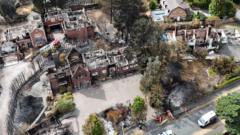
The destruction of nineteen homes in a single operational window highlights the susceptibility of the built environment to wildfire exposure. Research in fire dynamics indicates that structures rarely ignite from direct contact with a wall of forest flames. Instead, destruction occurs through three distinct, quantifiable vectors: ember transport, radiant heat flux, and direct flame impingement.
Ember storms represent the primary vector for structural ignition in suburban-wildland interfaces. Burning material lofted by convective columns travels miles ahead of the main front, landing on vulnerable building components.
- Roof Assemblies: Non-rated shingles and accumulated debris in valleys or gutters act as immediate landing pads for wind-driven embers.
- Venture and Eave Openings: Unprotected attic vents allow high-temperature embers to enter interior spaces, initiating combustion hidden from exterior suppression crews.
- Defensible Space Deficits: Flammable vegetation, wood fencing, and combustible outdoor furniture placed within five feet of an exterior wall create continuous thermal pathways.
Addressing this vulnerability requires shifting building codes from voluntary guidelines to mandatory performance standards. Retrofitting existing housing stock in high-risk zones involves hardening ignition zones through non-combustible material substitution and continuous maintenance protocols that eliminate organic accumulation within the immediate perimeter of the structure.
Logistics and Resource Allocation Bottlenecks
Emergency response effectiveness is constrained by logistical bottlenecks that govern resource deployment speed and distribution. When national alerts are triggered, the operational challenge transitions from tactical firefighting to complex supply chain management.
Command structures face severe latency issues when translating regional incident data into coordinated asset deployment. Aerial firefighting resources, including heavy air tankers and specialized helicopters, are constrained by strict operational parameters. High wind speeds, thick smoke plumes that reduce visual flight rules visibility, and limited access to retardant-loading bases frequently ground these assets precisely when their mitigation potential is highest.
Concurrently, ground resource distribution suffers from infrastructure limitations. Wildland-urban interface zones often feature single-point ingress and egress routes. When evacuation traffic and incoming emergency apparatus compete for the same narrow road network, a spatial gridlock occurs. This dynamic increases civilian life safety risks and prevents suppression apparatuses from establishing tactical anchor points before fire fronts arrive.
To optimize future operational responses, emergency management agencies must transition from static mutual-aid models to predictive, algorithmic resource positioning. Pre-positioning heavy equipment based on real-time fuel moisture indices, wind vector modeling, and historical ignition hot spots reduces deployment latency and alters the tactical timeline of containment efforts.
Strategic Asset Hardening and Risk Transfer
Mitigating future catastrophic structural loss requires a fundamental restructuring of how communities value, insure, and defend property in high-risk zones. Reliance on public sector suppression agencies is an incomplete strategy given the scale of expanding wildland-urban interfaces. Property owners and municipal planners must adopt proactive asset hardening that alters the cost function of wildfire impact.
Municipal zoning must integrate mandatory risk assessments that restrict new construction in high-convective corridors unless specific structural engineering thresholds are met. Simultaneously, insurance markets must recalibrate underwriting practices to reward verified property-level mitigation rather than utilizing blunt regional risk classifications that penalize homeowners regardless of individual property upkeep.
Integrating high-resolution predictive modeling with localized building code enforcement establishes a resilient baseline. Communities that systematically reduce structural ignition potential and enforce fuel management buffers reduce the kinetic energy of approaching fire fronts, transforming catastrophic events into manageable suppression incidents.