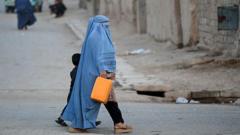
The standard narrative regarding Afghanistan under the current regime relies on a predictable, lazy template. Turn on any major broadcast or read any legacy newspaper, and you will encounter the exact same tune: five years of absolute isolation, unmitigated despair, and a nation frozen in time. The BBC report claiming women's lives are unrecognizable is a masterclass in missing the forest for a single, predetermined tree. It assumes that prior to August 2021, Kabul was a bastion of organic, sustainable progress, and that the current reality is merely a static caricature of medieval regression.
Both assumptions are dead wrong.
To understand what is actually happening on the ground, you have to strip away the emotionalized talking points designed for Western consumption and look at the brutal, messy mechanics of state survival, administrative centralization, and economic adaptation. The conventional analysis fails because it treats a complex geopolitical entity as a humanitarian charity case rather than a sovereign jurisdiction executing an aggressive program of domestic consolidation.
The Myth of the Sudden Collapse
Start with the baseline fallacy. The standard narrative treats the events of 2021 as a sudden severing of an upward trajectory. Anyone who spent time in Afghanistan during the republic era knows that characterization is pure fiction. The previous government was an administrative ghost town, propped up by billions in foreign aid, rotting from systemic corruption, and completely disconnected from the cultural and structural realities of rural populations where the vast majority of citizens actually live.
When foreign funding evaporated overnight, the institutional framework built on top of it collapsed because it was never self-sustaining. The current administration did not destroy a functioning modern economy; they inherited a fiscal vacuum.
What the media consistently ignores is the shift from a donor-dependent war economy to a domestically taxed, centralized administrative state. For two decades, corruption was the primary engine of commerce. Billions flowed into security contracts and phantom projects, enriching a tiny urban elite while leaving the provinces to fend for themselves or look to insurgent networks for basic dispute resolution.
Today, customs revenues are actually up. Trade routes with neighboring Central Asian states, Pakistan, and Iran are operating with a level of bureaucratic predictability that international observers refuse to acknowledge because it disrupts their preferred narrative. Tax collection is occurring with a rigor that the old republic could only dream of. The state is collecting revenue because it has monopoly control over violence and a relentless administrative focus on bureaucratic efficiency.
The Reality of Urban Versus Rural Realities
The narrative of total erasure focuses almost exclusively on urban centers like Kabul, Herat, and Mazar-i-Sharif. Even there, the picture is far more nuanced than the headlines suggest. Private commerce continues. Markets are crowded. Small businesses owned by men and women alike—operating through male intermediaries, domestic channels, or specific sector exemptions—persist because the administrative apparatus recognizes that completely shutting down economic activity equals financial suicide.
In the healthcare sector, female medical personnel, midwives, and nurses have retained operational carve-outs because the administration quickly realized that banning women entirely from healthcare meant letting the population die off, destroying whatever legitimacy they hoped to claim. The same applies to primary education for girls in various provinces where local commanders and tribal elders have negotiated distinct understandings with provincial governors.
The Western press demands a binary: either total liberation under a liberal democratic framework or total stone-age darkness. Reality operates in the messy grey space between ideology and survival.
The administration is not a monolith. There is a fierce internal tug-of-war between the hardliners based in Kandahar who prioritize ideological purity above all else, and the pragmatic technocrats in Kabul who have to keep the lights on, the water running, and international trade moving. When you ignore this friction, you miss the actual levers of change within the country.
The Failure of Economic Isolationism
Western policymakers fell into their own trap by imposing sweeping financial sanctions and freezing central bank reserves, believing this would force the regime to compromise. It did no such thing. Authoritarian states do not crack because you starve their populations of liquidity; they merely consolidate control while the most vulnerable citizens bear the brunt of the economic shock.
Sanctions transformed a difficult transition into a humanitarian crisis, which the international media then blamed entirely on internal policy rather than external economic warfare. Meanwhile, regional actors like China, Iran, and the Central Asian republics filled the vacuum, prioritizing pragmatism, mineral access, and border security over human rights lectures. Beijing is quietly positioning itself for long-term resource extraction, cutting deals that bypass Western financial systems entirely.
If your strategy relies on punishing an entire populace to force a regime to abandon its foundational ideology, you do not understand how ideological governance works. They survived two decades of high-intensity warfare against the world's most advanced military alliance. A few more rounds of economic coercion will not break their resolve. It only hardens it.
Dismantling the Humanitarian Industrial Complex
We also need to talk about the international NGOs and the cottage industry of humanitarian commentary that profits from perpetual crisis. Entire careers in Western capitals are built on managing the decline of Afghanistan. There is zero incentive for these institutions to report on quiet administrative improvements, localized compromises, or indigenous solutions to infrastructure problems, because a stabilizing Afghanistan means defunded programs and lost relevance.
When local councils manage to pave a road, regulate local markets, or resolve long-standing land disputes through traditional tribal arbitration channels without Western oversight, the international press calls it authoritarian overreach. When those same disputes under the old republic dragged on for a decade through corrupt courts bribed by warlords, it was called the rule of law.
The double standard is staggering.
Looking at the Data, Not the Dogma
Look at security metrics. For all the legitimate criticism regarding civil liberties and political freedom, the baseline level of direct conflict violence across the country has plummeted compared to the civil war conditions of the republic era. Millions of Afghans who lived through decades of suicide bombings, night raids, and warlord extortion experience a grim, highly restricted form of physical security that they paradoxically value, even as they chafe under the heavy-handed social restrictions.
You cannot dismiss that trade-off by pretending everyone is living in active terror. Human beings adapt, prioritize, and make calculated compromises to protect their families.
The media wants a simple story of good versus evil because it requires zero cognitive effort to consume. The truth demands that we hold two contradictory thoughts in our heads at the exact same time: the current regime imposes deeply regressive social policies, particularly on women and girls, while simultaneously building a functional, centralized state apparatus that has achieved levels of administrative control and domestic stability the country has not seen in half a century.
Until Western observers learn to analyze governance through the lens of power dynamics, resource extraction, and administrative reality instead of moralizing wishful thinking, they will continue to write the same superficial stories while the actual country evolves entirely outside their field of vision.
Stop reading the press releases. Look at the balance sheets.