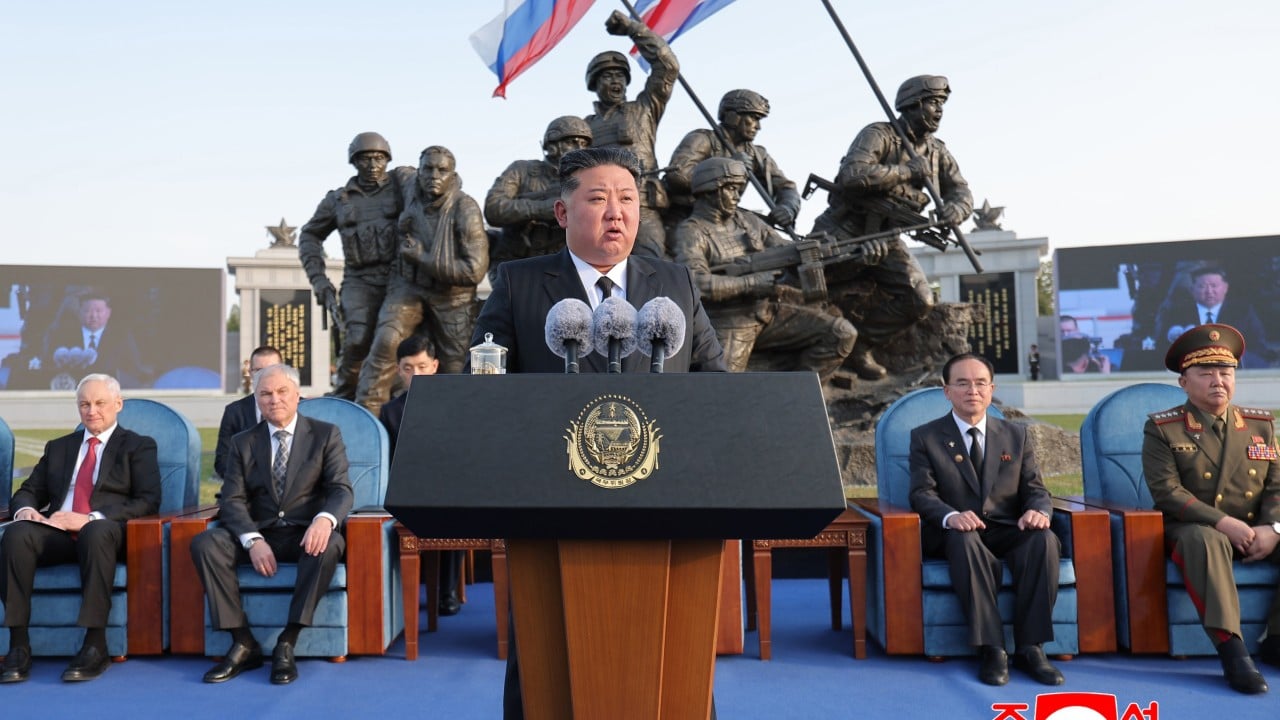
Pyongyang just made its "blood alliance" with Moscow permanent. Over the weekend, Kim Jong Un stood in front of a brand-new, neoclassical memorial museum to honor North Korean soldiers who died fighting on the front lines of the Russia-Ukraine war. This isn't just about paying respects to the dead. It's a loud, clear signal that the North Korean military is no longer just a regional threat—it’s now a global player with real combat experience.
Russian Defense Minister Andrei Belousov and State Duma Speaker Vyacheslav Volodin didn't just show up for the ribbon-cutting. They were there to cement a military cooperation plan that stretches all the way to 2031. If you thought North Korea's involvement in Ukraine was a one-off transaction for food and fuel, you're dead wrong. This is the birth of a long-term, institutionalized military axis that should make every NATO strategist lose sleep.
The Cost of the Kursk Offensive
The memorial specifically commemorates the North Korean troops who helped Russia repel the Ukrainian incursion into the Kursk region. Think about the numbers for a second. While Pyongyang and Moscow keep their casualty figures under lock and key, South Korean intelligence (NIS) estimates are grim. Since the deployment began in late 2024, roughly 15,000 North Korean soldiers have been sent to the Russian front.
Out of those, it's estimated that 2,000 have been killed and nearly 4,000 wounded. That’s a staggering 40% casualty rate. Most of these guys were young, poorly equipped for modern drone warfare, and dropped into a meat grinder they didn't understand. But Kim doesn't care about the body count. To him, those lives were a down payment on Russian nuclear technology and satellite expertise.
What the Soldiers Left Behind
Inside the museum, you won't just find names on a wall. There's a massive display of captured Western hardware—the "spoils of war." We're talking about charred Leopard 2A4 tanks, M1A1 Abrams, and Marder infantry fighting vehicles. It's a propaganda masterclass designed to show the North Korean public that "U.S.-led hegemonic plots" can be defeated with "Korean heroism."
Kim even took the time to physically throw dirt onto the remains of a fallen soldier during the ceremony. It’s a rare display of public mourning for a leader who usually focuses on missile launches and factory inspections. By framing these deaths as a "sacred war" for sovereignty, he’s prepping his population for the possibility that more young men will be heading to the European front.
The 2027 to 2031 Military Roadmap
The most chilling part of the Sunday ceremony wasn't the memorial itself. It was the talk of a five-year military cooperation plan spanning 2027 to 2031. This is the "post-Ukraine" strategy. Russia isn't just buying shells and cannon fodder anymore; they’re helping Kim build a modern, high-tech army.
- Drone Warfare: North Korea has already established a new unmanned aerial vehicle department. They're taking the data from the FPV drone strikes that decimated their troops in Kursk and using it to mass-produce their own "suicide drones."
- Satellite Tech: Remember those failed satellite launches? With Russian engineers now essentially on the North Korean payroll, those failures are becoming a thing of the past.
- Nuclear Submarines: This is the big one. There's growing evidence that Russia is sharing sensitive data on nuclear propulsion, something that would give Kim a second-strike capability that the U.S. can't easily track.
Why Experience Matters More Than Ammo
For decades, the North Korean People's Army (KPA) was a paper tiger. Millions of soldiers, sure, but zero combat experience since the 1950s. Ukraine changed that. The survivors of the Kursk offensive are now heading back to North Korea as battle-hardened veterans. They know how to fight under a sky full of electronic jamming and thermal-seeking drones.
They’ve seen how Western armor moves. They’ve learned how to coordinate with a foreign superpower in real-time. You can't buy that kind of training in a simulator. The NIS reports that about 1,100 of these "veteran" engineers and troops have already cycled back to the North to train the next wave. Kim is basically using the Ukraine war as a live-fire laboratory to upgrade his entire military doctrine.
The Reality Check
Don't let the white balloons and neoclassical architecture of the museum fool you. This is a cold-blooded trade. Putin gets the manpower he needs to hold his border without declaring another politically risky mobilization in Russia. Kim gets the technical keys to the kingdom and a way to bypass every sanction ever thrown at him.
If you're waiting for the UN or the West to "de-escalate" this situation, don't hold your breath. The mutual defense pact signed in June 2024 is now a physical reality on the ground. When Kim said the spirits of these dead soldiers would support a "victorious march," he wasn't just talking about Ukraine. He was talking about the Korean Peninsula.
If you want to understand where this is heading, keep your eyes on the joint exercises scheduled for later this year. We're likely to see Russian and North Korean naval units operating together in the Sea of Japan for the first time. The geopolitical map hasn't just shifted; it's been redrawn.
Stay informed by tracking the updates from the South Korean National Intelligence Service and independent monitors like 38 North. The next five years of this partnership will likely define the security of the Pacific—and the world—for the rest of the decade.