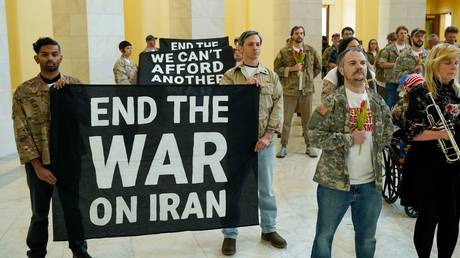
When Capitol Hill lawmakers gather to vote on restricting presidential military action against Iran, the outcome is almost always written before the roll call begins. Congress fails to restrict presidential war powers not because of constitutional ambiguity, but because of a deliberate, decades-long shift in how politicians manage risk. By surrendering their sole authority to declare war, lawmakers protect themselves from electoral backlash while allowing the executive branch to conduct military campaigns unhindered by legislative oversight.
The constitutional architecture was intentionally designed to make waging foreign conflict difficult. Article I grants Congress the sole power to declare war, creating a deliberate barrier against executive overreach. Yet, every attempt to invoke the 1973 War Powers Resolution to halt strikes against Iranian targets or force a withdrawal of American forces collapses under the weight of party loyalty and procedural maneuvering.
The Illusion of Legislative Control
The War Powers Resolution was meant to act as a emergency brake. Enacted over Richard Nixon’s veto in the shadow of the Vietnam War, the law requires a president to notify Congress within 48 hours of deploying armed forces into hostilities and forces a 60-day clock on unapproved operations.
It is a framework built on a fundamental misunderstanding of modern power dynamics. Presidents of both parties have spent fifty years systematically eroding the law, classifying missile strikes, targeted assassinations, and cyber warfare as falling below the legal threshold of actual hostilities.
When military strikes escalate in the Middle East, Capitol Hill responds with political theater rather than binding action. Sponsors introduce joint or concurrent resolutions to force a debate. Speeches are made on the Senate floor about constitutional duty and legislative integrity.
Then the political machinery grinds the effort into dust.
When resolutions manage to pass one chamber, they face insurmountable structural hurdles in the next. If a measure clears both the House and the Senate, it lands on the president's desk, where a swift veto ends the endeavor. Overriding a veto requires a two-thirds majority in both chambers. In an era defined by razor-thin majorities and hyper-partisanship, securing 67 Senate votes to curb a commander-in-chief from your own party is a mathematical fantasy.
The Fear That Governs Capitol Hill
To understand why these legislative efforts fail, look closely at the incentives driving individual lawmakers.
Voting for war carries enormous political danger if the conflict turns into a quagmire. Voting against military action opens a politician to accusations of weakness, lack of patriotism, or abandoning allies during a crisis.
The safest political position for a member of Congress is complete inaction combined with vocal commentary.
By allowing the White House to conduct military operations without explicit congressional authorization, lawmakers retain maximum flexibility. If a military strike succeeds in neutralizing a threat, politicians rush to claim credit for supporting a strong national defense. If an operation spirals into a broader conflict, those same politicians can attack the administration for reckless foreign policy without ever having put their names on a binding vote.
This dynamic creates a perverse incentive structure where Congress actively prefers to be powerless. The surrender of authority is not a defeat forced upon Capitol Hill by executive tyranny. It is an intentional shift of responsibility.
Legal Exploitation and Executive Loopholes
White House legal teams have perfected the art of circumventing legislative constraints. Rather than seeking fresh statutory authorization, executive branch lawyers assemble complex legal justifications built on decades of precedent and broad interpretations of Article II commander-in-chief powers.
Consider the reliance on outdated authorizations for use of military force. Administrations have repeatedly stretched the 2002 AUMF, originally written to target Saddam Hussein's regime in Iraq, to justify strikes against Iranian-backed militias operating across regional borders.
When forced to address the 60-day clock mandated by the War Powers Resolution, administration lawyers deploy creative definitions to reset the timer.
They argue that intermittent strikes do not constitute continuous hostilities. They claim that pause periods, localized ceasefires, or sudden shifts in operational objectives interrupt the timeline, resetting the statutory clock back to zero.
Furthermore, when Congress attempts to use non-binding concurrent resolutions or procedural measures to register disapproval, executive officials openly dismiss them. Because concurrent resolutions do not go to the president for a signature, legal scholars across multiple administrations have argued they lack the force of law under the 1983 Supreme Court ruling in INS v. Chadha, which struck down the legislative veto.
Congress is left attempting to fight rapid, high-tech executive warfare using a legislative toolkit that was declared legally defective four decades ago.
The Cost of Party Discipline
Partisanship acts as the ultimate buffer for executive war powers.
When a president orders strikes against Iranian infrastructure or high-ranking military commanders, the response on Capitol Hill aligns almost entirely with party affiliation. Members of the president's party who previously preached legislative primacy suddenly argue that constraining the commander-in-chief in the middle of a delicate operation damages national security and undermines diplomatic leverage.
Cross-party coalitions on foreign policy are fragile and temporary. A handful of libertarian-leaning Republicans and anti-interventionist Democrats regularly attempt to form coalitions to reassert legislative authority.
Their efforts are consistently dismantled by party leadership.
Floor leaders use procedural maneuvers to prevent war powers resolutions from reaching a final vote, stashing them in committee or attaching poison-pill amendments that alienate swing voters. When votes cannot be avoided, White House officials deploy intense pressure campaigns, reminding wavering senators that breaking rank on national security will draw primary challenges and public reprimands from the executive branch.
The result is a reliable defensive line. A president rarely needs to convince the entire legislature that a military campaign is wise; they only need to keep thirty-four senators in their corner to sustain a veto.
The Endless Cycle of Congressional Retreat
The debate over presidential authority regarding Iran is not an isolated legal dispute. It is the culmination of a system where the balance of power has been permanently altered through institutional habit.
Congress possesses the constitutional tools to stop any military conflict tomorrow if it truly wished to do so.
The legislative branch holds the power of the purse. Lawmakers can draft spending bills that explicitly ban federal funds from being used for offensive military operations against Iran without prior statutory authorization.
They refuse to do so.
Defunding a military operation requires real political courage and exposes lawmakers to the accusation that they are failing to support service members deployed in harm's way. Facing that choice, lawmakers retreat to symbolic resolutions that allow them to strike a posture for media cameras without taking any action that carries real legal consequences.
As long as Capitol Hill prioritizes political self-preservation over its constitutional duty, executive authority will continue to expand. The failure to restrict war powers is not an accident of the legislative process; it is the exact outcome the system was designed to produce when members of Congress decide that the burden of deciding on war is simply too heavy for them to carry.